
Housing market fundamentals remain challenging, with affordability continuing to be the industry's primary hurdle as home prices remain elevated relative to household incomes and price-to-income ratio...
- Housing market fundamentals remain challenging, with affordability continuing to be the industry's primary hurdle as home prices remain elevated relative to household incomes and price-to-income ratios remain stretched.
- Housing inventory has improved modestly, but gains remain highly uneven across regions and local markets.
- The current interest rate environment offers little incentive for a meaningful acceleration in home purchase activity, and any material improvement in affordability is likely to take time to develop.
- Mortgage origination volumes have recovered from the depressed levels experienced in 2025, but activity remains well below the extraordinary volumes recorded during the 2020-2021 refinancing boom.
- Refinance activity has rebounded, creating a healthier balance between purchase and refinance production and providing incremental support to industry profitability.
- The transition to a new Federal Reserve regime under Chair Warsh introduces additional uncertainty, and markets remain in the process of determining the longer-term direction of monetary policy.
Housing’s Biggest Obstacle Hasn’t Moved
Despite periodic bouts of market optimism and ongoing political debate surrounding monetary policy, mortgage rates have remained stubbornly elevated and are likely to stay that way for the foreseeable future. Inflation continues to exhibit signs of persistence, with tariff-related pricing pressures and elevated energy costs contributing to ongoing upward pressure on consumer prices.
Should the Federal Reserve ultimately move forward with an additional rate hike, the impact would be felt most acutely at the front end of the yield curve. Long-term interest rates, including the benchmark 10-Year Treasury yield, which remains well above 5.00%, would likely be less sensitive given the market's expectation of a positively sloped yield curve. Mortgage borrowers should also recognize that 30-year mortgage rates are typically priced at a spread meaningfully above the 10-Year Treasury yield, limiting the extent to which modest changes in Treasury rates translate into lower mortgage borrowing costs.
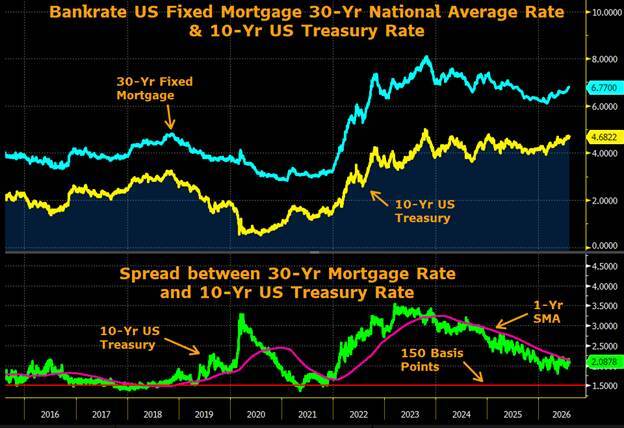
It is also important to remember that the Effective Federal Funds Rate currently stands near 3.875% and represents an overnight lending rate between financial institutions. While Federal Reserve actions have a significant influence on short-term borrowing costs, they do not directly determine mortgage rates. As a result, even if policy rates fluctuate modestly from current levels, prospective homebuyers should not expect an immediate or substantial decline in mortgage financing costs.
The mortgage rate lock-in effect remains a meaningful headwind for housing turnover and refinance activity. Approximately 78% of outstanding mortgage loans carry rates below 6%, leaving relatively few borrowers positioned to realize significant savings through a traditional refinance. Consequently, refinance opportunities are likely to remain selective and episodic rather than broad-based.
A Cyclical Recovery Taking Shape
While challenges remain, the industry is beginning to exhibit encouraging signs of stabilization. Mortgage originators and servicers have experienced modest improvements in profitability following several years of difficult operating conditions. Housing supply has improved incrementally, and demographic demand remains favorable as Gen Z and Millennial households slowly enter the market for home-ownership.
A large-scale refinance wave or housing boom remains a distant prospect, but the foundations for a gradual recovery are forming. Mortgage professionals should continue positioning their organizations for future opportunities while recognizing that the current environment calls for disciplined execution, customer retention, and targeted growth strategies.
The outlook remains cautiously constructive: the mortgage market is recovering, but growth is expected to be measured and moderate rather than rapid or explosive.

Let Us Know What You Thought about this Post.
Put your Comment Below.