
Housing market fundamentals remain challenging, with affordability continuing to be the industry's primary hurdle as home prices remain elevated relative to household incomes and price-to-income ratio...
The Nor’easter Impacts After the Bond Market Storm
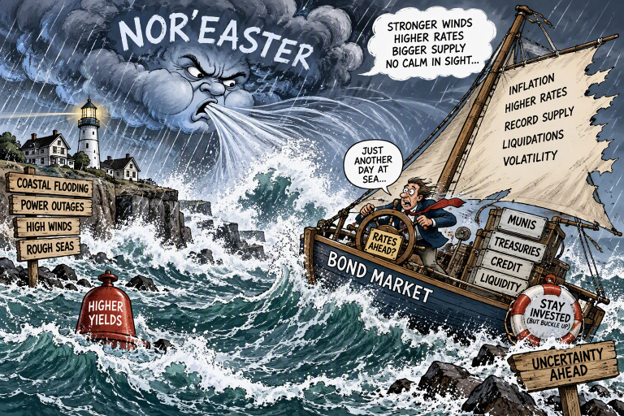
Fixed income markets were battered last week in a fitting prelude to the nor'easter that swept across much of the Northeast coastline over the weekend. While the storm's immediate impacts included power outages, coastal flooding, and widespread disruption to daily life, the forces unsettling financial markets appear likely to be far more persistent.
As I have argued for several months, the disruptions facing the economy and markets are unlikely to prove transitory and may endure much longer than many investors anticipate.
 The selloff intensified on Wednesday as a combination of factors pushed Treasury yields decisively above an important technical resistance level. The initial catalyst was a much stronger-than-expected Purchasing Managers Index (PMI) report, with activity reaching its strongest level since 2021. Pressure then accelerated following a notably weak 5-Year Treasury auction, which saw yields move above 5% for the first time since 2007. Adding fuel to the move were more hawkish comments from Federal Reserve officials, including Barr's observation that "further policy adjustments are likely to be needed to ensure inflation comes down to target in a timely fashion." Meanwhile, Brent crude reversed its recent decline and moved back above $95 per barrel, reinforcing inflation concerns.
Markets have responded by repricing the path of monetary policy.
Futures now imply the possibility of as many as four additional rate hikes before the terminal Fed Funds target is reached. More importantly, investors are increasingly concerned that inflation is no longer being sustained solely by supply-side disruptions stemming from the conflict with Iran. Instead, evidence is mounting that stronger demand may now be contributing to upward price pressures, a dynamic that is typically more difficult for policymakers to contain.
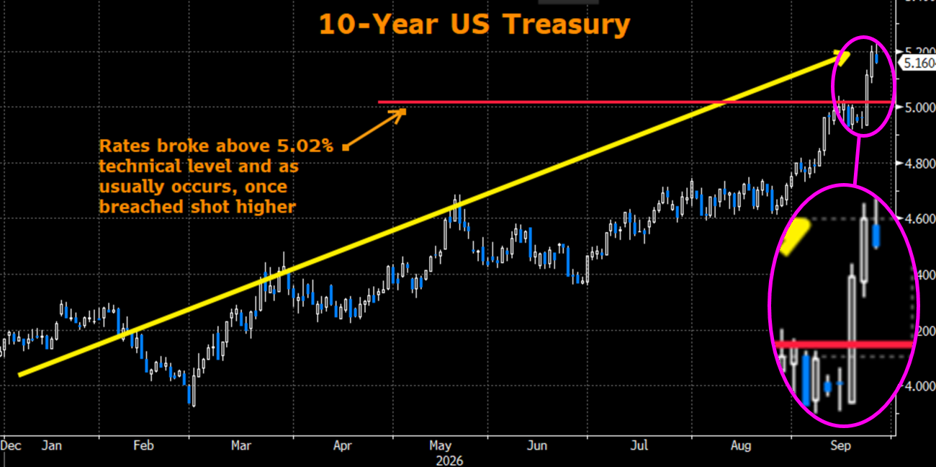 My forecast for 10-Year Treasury yields to revisit the 2007 peak near 5.32% remains unchanged.
Once that level is reached, the natural question becomes what comes next. From a technical perspective, the next meaningful targets lie near 5.40%, followed by the 2001 high of approximately 5.53%. Until there is convincing evidence that inflationary pressures are beginning to moderate, or that economic activity is slowing sufficiently to alter the policy outlook, I see little reason to expect the prevailing upward trend in rates to reverse. Much like the nor'easter that lingered longer and proved stronger than many expected, the forces driving rates higher continue to intensify, suggesting the storm for fixed income markets is not yet over.
From the Municipal Desk
Contributions from Ryan Riffe
The municipal bond market selloff intensified this week as renewed inflation concerns and stronger-than-expected midweek PMI data pushed rates sharply higher across the curve. By Friday's close, benchmark yields in the 1-3 year segment had risen by as much as 48 basis points, while intermediate and long-term maturities moved up nearly 30 basis points.
Pressure on municipals has been building since mid-summer as Treasury yields surged higher amid a relentless calendar of new issuance.
This week's selloff was exacerbated by a wave of liquidations, with institutional and retail investors alike bringing supply to market at the fastest pace seen since the COVID-era dislocations.
The combination of rising underlying rates, heavy issuance, and forced selling created a particularly challenging backdrop for municipal investors.
The market will now turn its attention to approximately $11 billion of new issue supply scheduled for next week, closing out what has been a particularly volatile and difficult September. With Treasury yields continuing to press higher and inflation concerns resurfacing, the municipal market remains firmly at the mercy of the broader rates environment.
Weekly Cuts (Yield Increase) to MMD Benchmarks
- 2027: 48 bp
- 2028–2029: 45 bp
- 2030: 42 bp
- 2031: 41 bp
- 2032–2033: 39 bp
- 2034: 33 bp
- 2035: 32 bp
- 2036: 30 bp
- 2037–2040: 26 bp
- 2041–2043: 25 bp
- 2044–2045: 24 bp
- 2046–2047: 23 bp
- 2048: 21 bp
- 2049: 20 bp
- 2050: 19 bp
- 2051–2056: 18 bp

An index is unmanaged and not available for direct investment. Definitions sourced from Bloomberg.
The Bloomberg Barclays Global Aggregate Negative Yielding Debt Market Value Index represents the portion of the Bloomberg Barclays Global Aggregate Index that measures the aggregate value of global debt with a negative yield. • The S&P 500® is widely regarded as the best single gauge of large-cap U.S. equities and serves as the foundation for a wide range of investment products. The index includes 500 leading companies and captures approximately 80% coverage of available market capitalization. • The NASDAQ Composite Index is a broad-based capitalization-weighted index of stocks in all three NASDAQ tiers: Global Select, Global Market and Capital Market. The index was developed with a base level of 100 as of February 5, 1971.• The Cboe Volatility Index® (VIX) is a calculation designed to produce a measure of constant, 30-day expected volatility of the US stock market, derived from real-time, mid-quote prices of weekly S&P 500® Index (SPX) call and put options with a range of 23 to 37 days to expiration.• The ICE BofA MOVE Index is a yield curve weighted index of the normalized implied volatility on 1-month Treasury options. It is the weighted average of implied volatilities on the CT2 (Current 2 Year Government Note), CT5 (Current 5 Year Government Note), CT10 (Current 10 Year Government Note), and CT30 (Current 30 Year Government Note), with weights 0.2/0.2/0.4/0.2 respectively.• The Markit CDX North America Investment Grade Index is composed of 125 equally weighted credit default swaps on investment grade entities, distributed among 6 sub-indices: High Volatility, Consumer, Energy, Financial, Industrial, and Technology, Media & Tele-communications. Markit CDX indices roll every 6 months in March & September. • The Markit CDX North America High Yield Index is composed of 100 non-investment grade entities, distributed among 2 sub-indices: B, BB. All entities are domiciled in North America. Markit CDX indices roll every 6 months in March & September. • The U.S. Dollar Index (USDX) indicates the general international value of the USD. The USDX does this by averaging the exchange rates between the USD and major world currencies. Intercontinental Exchange (ICE) US computes this by using the rates supplied by some 500 banks.
Investing involves certain risks, including possible loss of principal. You should understand and carefully consider a strategy’s objectives, risks, fees, expenses, and other information before investing. The views expressed in this commentary are subject to change and are not intended to be a recommendation or investment advice. Such views do not take into account the individual financial circumstances or objectives of any investor that receives them. All indices are unmanaged and are not available for direct investment. Indices do not incur costs including the payment of transaction costs, fees, and other expenses. This information should not be considered a solicitation or an offer to provide any service in any jurisdiction where it would be unlawful to do so under the laws of that jurisdiction. Past performance is no guarantee of future results.
© 2025 SWBC. All rights reserved. Securities offered through SWBC Investment Services, LLC, a registered broker/dealer. Member FINRA & SIPC. Advisory services offered through SWBC Investment Company, a Registered Investment Advisor, registered as such with the US Securities & Exchange Commission. SWBC Investment Services, LLC is under separate ownership from any other named entity. SWBC Investment Services, LLC a division of SWBC, is a nationwide partnership of advisor.

Let Us Know What You Thought about this Post.
Put your Comment Below.