
A Welcome Breather Traders were finally able to catch their breath, at least temporarily, after several weeks of volatility that kept markets firmly on edge. The week concluded on a relatively quiet n...
A Welcome Breather
Traders were finally able to catch their breath, at least temporarily, after several weeks of volatility that kept markets firmly on edge. The week concluded on a relatively quiet note as fears that interest rates would continue their relentless climb eased, allowing investors a brief reprieve from the day-to-day swings that have dominated market sentiment.
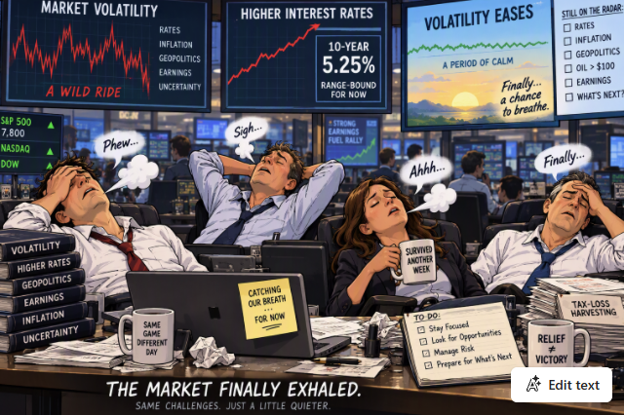 The geopolitical backdrop remained a focal point. While tensions in the Middle East appeared to cool once again, oil prices showed little interest in following suit. Crude briefly dipped but remained firmly above the $100 per barrel threshold, reflecting ongoing concerns surrounding global production and distribution risks. Meanwhile, equities continued to display impressive resilience, largely shrugging off the growing challenges posed by a higher rate environment that would ordinarily threaten the optimistic growth narrative supporting current valuations.
Despite concerns that the 30-year Treasury auction could encounter resistance amid elevated yields, the offering passed without incident and rates largely remained range-bound.
Following the sharp moves witnessed in recent weeks, a period of consolidation was both anticipated and ultimately delivered. That said, higher yields were tested intraday, with the 10-year Treasury briefly reaching a fresh cycle high of 5.36% before ending the week closer to 5.25%. Economic data offered little conviction for investors heading into the three-day holiday weekend, leaving markets without a meaningful catalyst in either direction.
 Expectations for additional Federal Reserve tightening also moderated. Fed funds futures now imply only about a 20% probability of a rate hike this month before the midterm elections. Recent comments from Fed officials reinforced a patient approach, with both John Williams and Philip Jefferson emphasizing that policymakers can afford to take additional time before determining their next move.
Christopher Waller struck a somewhat more hawkish tone, noting that further tightening may ultimately be necessary to return inflation to target, while acknowledging flexibility regarding the timing of any future action.
Geopolitical developments also failed to provide the relief rally some investors had anticipated. Although President Trump suggested that no further attacks would occur prior to the midterm elections, oil prices remained stubbornly above $100 per barrel. Several months ago, such comments might have sparked a significant market response. Today, however, investors appear increasingly skeptical of headline-driven forecasts, particularly when inflation risks and the strategic interests of regional actors continue to argue against a swift de-escalation.
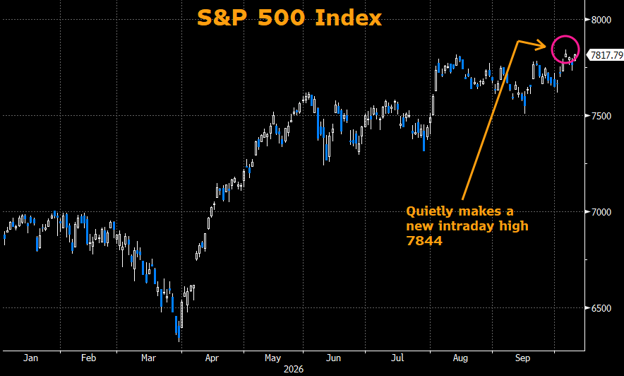
Against this backdrop, the S&P 500 quietly reached another milestone, climbing to a new high near 7,844 before finishing the week just above 7,800.
Historically, 10-year Treasury yields north of 5% would present a meaningful obstacle for equities, particularly growth-oriented sectors. Yet stocks have continued to advance, supported by strong earnings results and favorable profit growth expectations. Beneath the surface, however, participation has narrowed considerably, with a relatively small group of technology and AI-related companies accounting for much of the market's strength. Investors continue to view AI-driven spending and productivity gains as a multi-year structural theme, allowing the market to look beyond the potential drag that higher interest rates may eventually impose on economic growth.
For now, traders have been granted something that has been in short supply lately: a chance to step back, assess the landscape, and catch their breath. Whether that calm proves lasting or merely an intermission remains one of the market's most pressing questions.
From the Municipal Desk
Contributions from Ryan Riffe
The terms volatile and turbulent have been used repeatedly to describe the current municipal market landscape, and this past week provided little reason to challenge that characterization. Benchmark yields continued to experience significant day-to-day swings, highlighting the unsettled nature of the market.
While municipals have generally tracked movements in Treasuries, a noticeable dislocation has emerged over the last two weeks. That divergence was on full display Friday, when benchmark municipal yields rallied by as much as 12 basis points even as Treasury yields moved higher.
The catalyst behind the muni-Treasury disconnect may be the extraordinary volume of bid-wanteds entering the market. When compared to other periods marked by severe municipal market stress, including the COVID-driven selloff, the 2023 banking crisis, and the Liberation Day tariff volatility, the level of bid-wanteds seen over the past two weeks has exceeded each of those episodes.
As a result, tax-loss harvesting has become a dominant force in market activity.
Investors are increasingly seeking to take advantage of the stark contrast between equity markets sitting near record highs and municipal valuations that have fallen to generational lows.
Looking ahead, the market will absorb approximately $8.5 billion of new issue supply during the shortened holiday week. We expect current conditions to remain in place as elevated tax-loss harvesting activity continues to collide with persistent interest rate volatility, keeping pressure on valuations and contributing to ongoing market dislocations.
Muni-Ratios
| 2-YR | 68% |
| 3YR | 68% |
| 5-YR | 70% |
| 10-YR | 76% |
| 30-YR | 91% |

An index is unmanaged and not available for direct investment. Definitions sourced from Bloomberg.
The Bloomberg Barclays Global Aggregate Negative Yielding Debt Market Value Index represents the portion of the Bloomberg Barclays Global Aggregate Index that measures the aggregate value of global debt with a negative yield. • The S&P 500® is widely regarded as the best single gauge of large-cap U.S. equities and serves as the foundation for a wide range of investment products. The index includes 500 leading companies and captures approximately 80% coverage of available market capitalization. • The NASDAQ Composite Index is a broad-based capitalization-weighted index of stocks in all three NASDAQ tiers: Global Select, Global Market and Capital Market. The index was developed with a base level of 100 as of February 5, 1971.• The Cboe Volatility Index® (VIX) is a calculation designed to produce a measure of constant, 30-day expected volatility of the US stock market, derived from real-time, mid-quote prices of weekly S&P 500® Index (SPX) call and put options with a range of 23 to 37 days to expiration.• The ICE BofA MOVE Index is a yield curve weighted index of the normalized implied volatility on 1-month Treasury options. It is the weighted average of implied volatilities on the CT2 (Current 2 Year Government Note), CT5 (Current 5 Year Government Note), CT10 (Current 10 Year Government Note), and CT30 (Current 30 Year Government Note), with weights 0.2/0.2/0.4/0.2 respectively.• The Markit CDX North America Investment Grade Index is composed of 125 equally weighted credit default swaps on investment grade entities, distributed among 6 sub-indices: High Volatility, Consumer, Energy, Financial, Industrial, and Technology, Media & Tele-communications. Markit CDX indices roll every 6 months in March & September. • The Markit CDX North America High Yield Index is composed of 100 non-investment grade entities, distributed among 2 sub-indices: B, BB. All entities are domiciled in North America. Markit CDX indices roll every 6 months in March & September. • The U.S. Dollar Index (USDX) indicates the general international value of the USD. The USDX does this by averaging the exchange rates between the USD and major world currencies. Intercontinental Exchange (ICE) US computes this by using the rates supplied by some 500 banks.
Investing involves certain risks, including possible loss of principal. You should understand and carefully consider a strategy’s objectives, risks, fees, expenses, and other information before investing. The views expressed in this commentary are subject to change and are not intended to be a recommendation or investment advice. Such views do not take into account the individual financial circumstances or objectives of any investor that receives them. All indices are unmanaged and are not available for direct investment. Indices do not incur costs including the payment of transaction costs, fees, and other expenses. This information should not be considered a solicitation or an offer to provide any service in any jurisdiction where it would be unlawful to do so under the laws of that jurisdiction. Past performance is no guarantee of future results.
© 2025 SWBC. All rights reserved. Securities offered through SWBC Investment Services, LLC, a registered broker/dealer. Member FINRA & SIPC. Advisory services offered through SWBC Investment Company, a Registered Investment Advisor, registered as such with the US Securities & Exchange Commission. SWBC Investment Services, LLC is under separate ownership from any other named entity. SWBC Investment Services, LLC a division of SWBC, is a nationwide partnership of advisor.

Let Us Know What You Thought about this Post.
Put your Comment Below.