
The Market's Favorite Story Meets Skeptical Investors Market attention last week remained firmly focused on the sustainability of the AI investment cycle and whether current levels of capital expendit...
The Market's Favorite Story Meets Skeptical Investors
Market attention last week remained firmly focused on the sustainability of the AI investment cycle and whether current levels of capital expenditure can continue to support the earnings and revenue growth expectations embedded across the technology sector. Investor concerns intensified following NVIDIA's earnings release and the accompanying headlines surrounding CEO Jensen Huang, both of which further amplified scrutiny of the AI narrative. Meanwhile, the highly anticipated and record-setting Anthropic IPO initially provided a measure of optimism for growth investors; however, the offering ultimately failed to reignite the momentum that has defined the technology trade for much of the past several years.
The combination of these developments accelerated a broad unwinding of AI-related positioning and contributed to a significant deterioration in market sentiment.
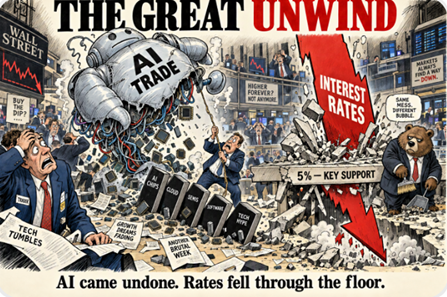
The resulting risk-off environment triggered a pronounced flight-to-quality move across financial markets. Investors sought the safety and liquidity of U.S. Treasury securities, producing a strong rally in bonds and pushing interest rates notably lower. Most significantly, the 10-year Treasury yield reversed its recent move toward higher levels and fell below the psychologically and technically important 5.0% threshold, a level that had served as meaningful support in recent months.
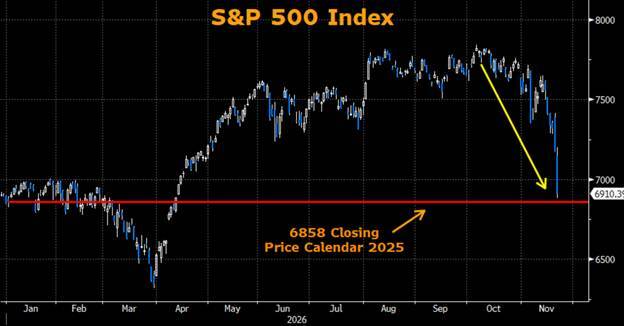
Equity markets absorbed the impact of both the AI-driven sell-off and shifting rate expectations.
The S&P 500 erased prior gains and declined to levels not seen since April, reducing year-to-date performance from a peak gain of more than 13% earlier this year to nearly flat. Market leadership narrowed further, and many of the companies that had been primary beneficiaries of the AI investment theme experienced outsized declines as investors reassessed valuation assumptions and growth expectations.
Looking ahead, the Thanksgiving holiday-shortened trading week may provide an opportunity for markets to stabilize following the sharp volatility of recent sessions. However, the catalyst behind the sell-off remains unresolved. Questions regarding the durability of AI-driven spending, the pace of monetization, and the sustainability of elevated equity valuations continue to linger.
While periods of consolidation would be expected following such a significant correction, downside risks remain elevated.
Importantly, the same AI narrative that fueled several years of exceptional market performance is now facing its most meaningful test to date, and the recent sell-off may represent only the early stages of a broader repricing should investor expectations continue to moderate.
Attention will also turn toward the December 9 FOMC meeting, where the Federal Reserve is widely expected to increase the federal funds rate by 25 basis points in its ongoing effort to contain inflationary pressures. Although some policymakers, including Governor Christopher Waller, have acknowledged the possibility of more aggressive action, a 50-basis-point increase currently appears unlikely given the Committee's generally measured approach and desire to balance inflation concerns against emerging signs of slowing economic momentum.
Bottom Line: Last week's market action reflected more than a routine pullback.
The combination of a broad AI trade unwind, declining equity valuations, and a powerful rally in Treasuries suggests investors are becoming increasingly cautious about growth expectations and are repositioning portfolios accordingly. Whether this proves to be a temporary correction or the beginning of a more prolonged adjustment will likely depend on the durability of AI-related earnings growth and the Federal Reserve's ability to navigate an increasingly challenging economic backdrop.
From the Municipal Desk
Contributions from Ryan Riffe
Municipals spent most of the week under pressure, weakening each day until a Friday rally helped recover a portion of the losses. A robust $15 billion new-issue calendar, coupled with a renewed increase in customer bid-wanted activity, weighed on the market as investor demand struggled to keep pace with supply. Sentiment shifted meaningfully to close the week as the 10-year Treasury yield rallied from 5.05% to an intraday low of 4.90%, fueling a broader risk-off move across fixed income markets.
While municipals lagged the Treasury rally, the sector managed to break a seven-session streak of MMD cuts, leaving benchmark municipal yields only 2 to 5 basis points higher across most of the curve for the week.
More importantly, the recent repricing has improved relative value metrics and may be laying the groundwork for a stronger finish to 2026.
Looking ahead, market technicals continue to improve as seasonal reinvestment flows remain supportive and new issuance is expected to slow materially. Municipal-to-Treasury ratios have also moved into ranges that historically have attracted buyer interest, with 10-year ratios approaching 70% and 30-year ratios nearing 93%. Combined with a Thanksgiving holiday week that will feature less than $1 billion of new issuance across only three and a half trading days, the supply-demand backdrop appears increasingly favorable for the asset class as the year draws to a close.
Muni-Ratios
| 2-YR | 63% |
| 3YR | 64% |
| 5-YR | 67% |
| 10-YR | 70% |
| 30-YR | 93% |

An index is unmanaged and not available for direct investment. Definitions sourced from Bloomberg.
The Bloomberg Barclays Global Aggregate Negative Yielding Debt Market Value Index represents the portion of the Bloomberg Barclays Global Aggregate Index that measures the aggregate value of global debt with a negative yield. • The S&P 500® is widely regarded as the best single gauge of large-cap U.S. equities and serves as the foundation for a wide range of investment products. The index includes 500 leading companies and captures approximately 80% coverage of available market capitalization. • The NASDAQ Composite Index is a broad-based capitalization-weighted index of stocks in all three NASDAQ tiers: Global Select, Global Market and Capital Market. The index was developed with a base level of 100 as of February 5, 1971.• The Cboe Volatility Index® (VIX) is a calculation designed to produce a measure of constant, 30-day expected volatility of the US stock market, derived from real-time, mid-quote prices of weekly S&P 500® Index (SPX) call and put options with a range of 23 to 37 days to expiration.• The ICE BofA MOVE Index is a yield curve weighted index of the normalized implied volatility on 1-month Treasury options. It is the weighted average of implied volatilities on the CT2 (Current 2 Year Government Note), CT5 (Current 5 Year Government Note), CT10 (Current 10 Year Government Note), and CT30 (Current 30 Year Government Note), with weights 0.2/0.2/0.4/0.2 respectively.• The Markit CDX North America Investment Grade Index is composed of 125 equally weighted credit default swaps on investment grade entities, distributed among 6 sub-indices: High Volatility, Consumer, Energy, Financial, Industrial, and Technology, Media & Tele-communications. Markit CDX indices roll every 6 months in March & September. • The Markit CDX North America High Yield Index is composed of 100 non-investment grade entities, distributed among 2 sub-indices: B, BB. All entities are domiciled in North America. Markit CDX indices roll every 6 months in March & September. • The U.S. Dollar Index (USDX) indicates the general international value of the USD. The USDX does this by averaging the exchange rates between the USD and major world currencies. Intercontinental Exchange (ICE) US computes this by using the rates supplied by some 500 banks.
Investing involves certain risks, including possible loss of principal. You should understand and carefully consider a strategy’s objectives, risks, fees, expenses, and other information before investing. The views expressed in this commentary are subject to change and are not intended to be a recommendation or investment advice. Such views do not take into account the individual financial circumstances or objectives of any investor that receives them. All indices are unmanaged and are not available for direct investment. Indices do not incur costs including the payment of transaction costs, fees, and other expenses. This information should not be considered a solicitation or an offer to provide any service in any jurisdiction where it would be unlawful to do so under the laws of that jurisdiction. Past performance is no guarantee of future results.
© 2025 SWBC. All rights reserved. Securities offered through SWBC Investment Services, LLC, a registered broker/dealer. Member FINRA & SIPC. Advisory services offered through SWBC Investment Company, a Registered Investment Advisor, registered as such with the US Securities & Exchange Commission. SWBC Investment Services, LLC is under separate ownership from any other named entity. SWBC Investment Services, LLC a division of SWBC, is a nationwide partnership of advisor.

Let Us Know What You Thought about this Post.
Put your Comment Below.