
When the Unstoppable Force meets the Immovable Object The AI-driven equity sell-off stabilized earlier last week, effectively pausing the bond market rally that initially emerged from a classic flight...
When the Unstoppable Force meets the Immovable Object
The AI-driven equity sell-off stabilized earlier last week, effectively pausing the bond market rally that initially emerged from a classic flight-to-quality trade as risk-off sentiment dominated investor activity. A wait-and-see approach among bond traders ahead of the FOMC meeting likely contributed to the relatively subdued movement in interest rates as well.
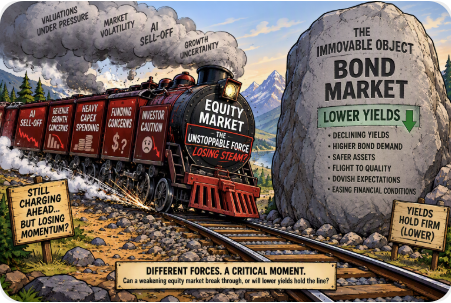
However, the AI rout regained momentum following weaker-than-expected earnings results from Alphabet. At the same time, third-quarter GDP data continued to suggest the U.S. economy remains resilient, inflation pressures remain elevated, and crude oil prices reached their highest level since May. Ordinarily, this combination of stronger growth, persistent inflation concerns, and higher energy prices would place upward pressure on Treasury yields rather than step aside as the AI-trade unwind created a solid bid in rates.
As widely anticipated, Chair Warsh and the Federal Reserve left the Federal Funds target range unchanged at 3.75%-4.00%.
Nevertheless, the overall tone of the meeting was decidedly hawkish. Policymakers highlighted continued labor market stability while reiterating concerns regarding inflation. Notably, both Lisa Cook and Beth Hammack dissented in favor of a 25-basis-point rate increase.
Perhaps the most significant development was not the rate decision itself, but rather the Fed's announced changes to future FOMC meetings. Beginning in late 2027, one annual meeting will be dedicated exclusively to longer-term monetary policy strategy, while the remaining meetings will continue to focus on interest-rate decisions. Starting in 2028, the Fed plans to hold two strategy-focused meetings and six rate-decision meetings annually. While details remain limited, the changes suggest Warsh intends to provide less frequent guidance on near-term rate policy while placing greater emphasis on longer-term strategic objectives.
Markets may be concerned that fewer scheduled opportunities for rate decisions could increase uncertainty and potentially contribute to greater volatility.
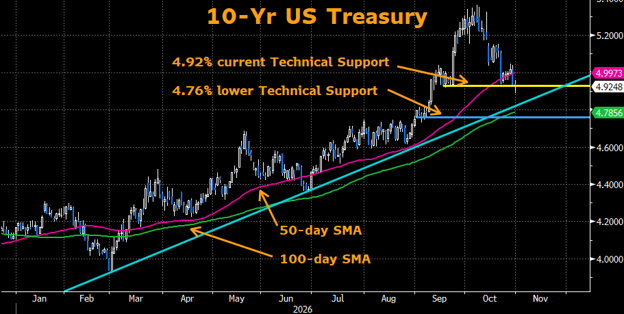
Meanwhile, the equity market's weakness, with the Nasdaq 100 declining approximately 2.7% and the S&P 500 falling roughly 1% during the week, underscores growing investor concerns that massive AI-related capital expenditures may fail to produce sufficient revenue growth to justify current spending levels and valuations.
The bond market's positive reaction to AI-related weakness reflects a textbook flight-to-quality move. However, the durability of that move remains questionable. The same fundamentals that pushed the 10-year Treasury yield above 5% earlier this year, namely persistent inflation pressures, strong economic activity, and an elevated federal debt burden, remain largely unchanged.
Investors should be cautious about assuming that the higher-rate environment is firmly behind us.
Finally, the Fed's preferred inflation measure, Personal Consumption Expenditures (PCE), increased again in September relative to the prior month. Although the September rate hike occurred near month-end, market interest rates had already been trending higher throughout the month, suggesting investors remain skeptical that a single increase in policy rates will be sufficient to fully contain inflationary pressures.
Key Takeaway
The recent decline in Treasury yields appears driven more by a temporary flight to safety amid AI-related equity weakness than by a meaningful change in the inflation or growth outlook. Unless economic growth slows more materially or inflation begins a more convincing downward trajectory, the fundamental forces that have kept upward pressure on long-term yields remain intact. In other words, lower yields may be winning the battle for the moment, but the war against higher interest rates is far from over.
From the Municipal Desk
Contributions from Ryan Riffe
The municipal market delivered another strong week, capping off one of the most constructive Octobers in recent memory. The rally in Treasuries provided an additional tailwind, with the 10-year Treasury yield moving comfortably below the 5.00% threshold. That backdrop allowed benchmark municipal yields to decline by roughly 4 to 13 basis points across the curve during the week.
The municipal yield curve continued to steepen, with the strongest demand concentrated in maturities of 15 years and shorter. Market performance was further supported by a lighter new-issue calendar, improving forward-looking technical conditions, and persistent two-way flows driven in part by tax-loss harvesting activity.
Looking ahead, the market now turns its attention to November and December, a period that has historically been favorable for municipal bonds.
Reinvestment proceeds are expected to increase naturally, while new-issue supply typically begins to taper off. Combined with generally healthy credit fundamentals, these supportive technical factors should provide the municipal market with an important cushion against what is likely to remain an environment of elevated interest-rate volatility.
The first week of November is expected to bring approximately $7 billion of new issuance, down from roughly $10 billion the prior week and well below the year-to-date weekly average of approximately $11 billion. If supply remains contained while seasonal reinvestment demand accelerates, the municipal market could remain well-positioned to navigate ongoing volatility and finish the year on relatively solid footing.
Muni-Ratios
| 2-YR | 57% |
| 3YR | 59% |
| 5-YR | 62% |
| 10-YR | 68% |
| 30-YR | 90% |

An index is unmanaged and not available for direct investment. Definitions sourced from Bloomberg.
The Bloomberg Barclays Global Aggregate Negative Yielding Debt Market Value Index represents the portion of the Bloomberg Barclays Global Aggregate Index that measures the aggregate value of global debt with a negative yield. • The S&P 500® is widely regarded as the best single gauge of large-cap U.S. equities and serves as the foundation for a wide range of investment products. The index includes 500 leading companies and captures approximately 80% coverage of available market capitalization. • The NASDAQ Composite Index is a broad-based capitalization-weighted index of stocks in all three NASDAQ tiers: Global Select, Global Market and Capital Market. The index was developed with a base level of 100 as of February 5, 1971.• The Cboe Volatility Index® (VIX) is a calculation designed to produce a measure of constant, 30-day expected volatility of the US stock market, derived from real-time, mid-quote prices of weekly S&P 500® Index (SPX) call and put options with a range of 23 to 37 days to expiration.• The ICE BofA MOVE Index is a yield curve weighted index of the normalized implied volatility on 1-month Treasury options. It is the weighted average of implied volatilities on the CT2 (Current 2 Year Government Note), CT5 (Current 5 Year Government Note), CT10 (Current 10 Year Government Note), and CT30 (Current 30 Year Government Note), with weights 0.2/0.2/0.4/0.2 respectively.• The Markit CDX North America Investment Grade Index is composed of 125 equally weighted credit default swaps on investment grade entities, distributed among 6 sub-indices: High Volatility, Consumer, Energy, Financial, Industrial, and Technology, Media & Tele-communications. Markit CDX indices roll every 6 months in March & September. • The Markit CDX North America High Yield Index is composed of 100 non-investment grade entities, distributed among 2 sub-indices: B, BB. All entities are domiciled in North America. Markit CDX indices roll every 6 months in March & September. • The U.S. Dollar Index (USDX) indicates the general international value of the USD. The USDX does this by averaging the exchange rates between the USD and major world currencies. Intercontinental Exchange (ICE) US computes this by using the rates supplied by some 500 banks.
Investing involves certain risks, including possible loss of principal. You should understand and carefully consider a strategy’s objectives, risks, fees, expenses, and other information before investing. The views expressed in this commentary are subject to change and are not intended to be a recommendation or investment advice. Such views do not take into account the individual financial circumstances or objectives of any investor that receives them. All indices are unmanaged and are not available for direct investment. Indices do not incur costs including the payment of transaction costs, fees, and other expenses. This information should not be considered a solicitation or an offer to provide any service in any jurisdiction where it would be unlawful to do so under the laws of that jurisdiction. Past performance is no guarantee of future results.
© 2025 SWBC. All rights reserved. Securities offered through SWBC Investment Services, LLC, a registered broker/dealer. Member FINRA & SIPC. Advisory services offered through SWBC Investment Company, a Registered Investment Advisor, registered as such with the US Securities & Exchange Commission. SWBC Investment Services, LLC is under separate ownership from any other named entity. SWBC Investment Services, LLC a division of SWBC, is a nationwide partnership of advisor.

Let Us Know What You Thought about this Post.
Put your Comment Below.