
Housing market fundamentals remain challenging, with affordability continuing to be the industry's primary hurdle as home prices remain elevated relative to household incomes and price-to-income ratio...
Rates Rip, Equities Slip: Duration Shock Triggers De-Risking
Markets remained anchored to developments in the war with Iran throughout the week, with geopolitical risk continuing to drive macro sentiment despite intermittent distraction from high-level diplomatic activity, including President Trump’s meetings with President Xi in China. While geopolitics dominated the narrative, incoming U.S. inflation data re-emerged as a central concern, reinforcing the view that price pressures remain persistent - particularly as elevated energy costs continue to feed into broader goods and services pricing.
Oil markets reflected this dynamic, with Brent crude steadily advancing to close just below $110/bbl. Although still below the late-April peak near $126/bbl, crude remains firmly bid as supply disruptions and ongoing uncertainty surrounding the Strait of Hormuz sustain upward pressure. Importantly, the inflation impulse from higher energy is no longer confined to the commodity complex, as increased transportation and input costs have begun to flow more meaningfully into core economic activity.
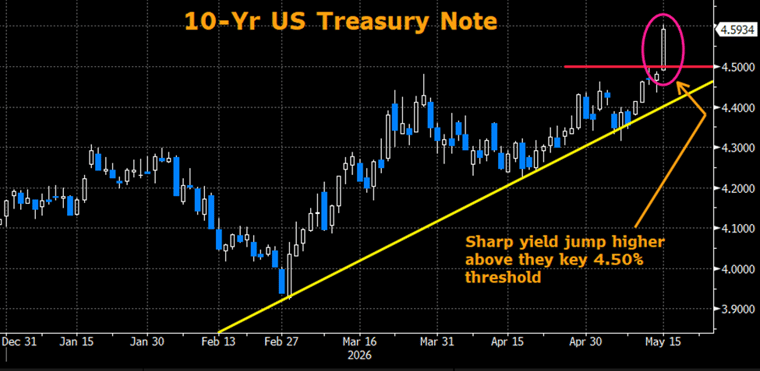
Equity markets, which exhibited resilience earlier in the week, appeared initially immune to the shift in the rate environment, with the S&P 500 reaching fresh all-time highs as recently as Thursday. However, Friday’s global bond market selloff ultimately triggered a reassessment of equity valuations. As long-term yields climbed - particularly with the 10-year moving decisively above 4.50% - the equity risk premium compressed, challenging the sustainability of elevated valuations.
The result was a sharp de-risking across equities, driven by a confluence of factors: stretched valuations, concentrated positioning in growth and technology sectors, and a recalibration of Federal Reserve expectations toward a more hawkish outlook, including the potential for additional rate hikes. The week’s price action underscores the market’s increasing sensitivity to changes in the rates regime, with fixed income once again dictating the direction of cross-asset performance.
After breaking through key technical resistance levels, I remain concerned that the path of least resistance for rates is higher. There appears to be additional room for yields to move upward, particularly across the short to intermediate segments of the curve out to 10 years. Until there is clearer evidence that a peak in rates has been established — or we approach a more meaningful higher resistance zone — we have taken a prudent approach by actively managing risk. This has included adjusting hedges and reducing long exposure to account for elevated uncertainty and the potential for further increases in rates.
From the Municipal Desk (with contributions from Ryan Riffe):
Despite a constructive backdrop supported by seasonal technicals and continued fund inflows, the municipal market was unable to withstand the sharp rise in Treasury rates. The week began on a relatively calm note, with participants waiting for the steady cadence of new issuance to build. Negotiated deals were quickly absorbed, with buyers maintaining a focus on intermediate and longer maturities. Many transactions were heavily oversubscribed and ultimately repriced to lower yield targets.
However, as the week progressed, a combination of steadily rising rates and a heavy forward calendar left municipals on the defensive. Friday’s global bond rout pushed investors to the sidelines, with benchmark muni yields rising by as much as five basis points on the day. In certain segments of the curve, yields moved higher by as much as fifteen basis points over the course of the week.
Fund flows remain supportive, with at least $1 billion of inflows recorded in three of the last four weeks. Paired with strong reinvestment demand, this has helped provide a degree of underlying stability. That said, we expect volatility to persist as the market works through evolving economic data and ongoing geopolitical developments in the weeks ahead.
Weekly Supply @ $14.00 Billion
Muni-Ratios
2-YR Ratio @ 63%
3-YR Ratio @ 63%
5-YR Ratio @ 64%
10-YR Ratio @ 67%
30-YR Ratio @ 87%

An index is unmanaged and not available for direct investment. Definitions sourced from Bloomberg.
The Bloomberg Barclays Global Aggregate Negative Yielding Debt Market Value Index represents the portion of the Bloomberg Barclays Global Aggregate Index that measures the aggregate value of global debt with a negative yield. • The S&P 500® is widely regarded as the best single gauge of large-cap U.S. equities and serves as the foundation for a wide range of investment products. The index includes 500 leading companies and captures approximately 80% coverage of available market capitalization. • The NASDAQ Composite Index is a broad-based capitalization-weighted index of stocks in all three NASDAQ tiers: Global Select, Global Market and Capital Market. The index was developed with a base level of 100 as of February 5, 1971.• The Cboe Volatility Index® (VIX) is a calculation designed to produce a measure of constant, 30-day expected volatility of the US stock market, derived from real-time, mid-quote prices of weekly S&P 500® Index (SPX) call and put options with a range of 23 to 37 days to expiration.• The ICE BofA MOVE Index is a yield curve weighted index of the normalized implied volatility on 1-month Treasury options. It is the weighted average of implied volatilities on the CT2 (Current 2 Year Government Note), CT5 (Current 5 Year Government Note), CT10 (Current 10 Year Government Note), and CT30 (Current 30 Year Government Note), with weights 0.2/0.2/0.4/0.2 respectively.• The Markit CDX North America Investment Grade Index is composed of 125 equally weighted credit default swaps on investment grade entities, distributed among 6 sub-indices: High Volatility, Consumer, Energy, Financial, Industrial, and Technology, Media & Tele-communications. Markit CDX indices roll every 6 months in March & September. • The Markit CDX North America High Yield Index is composed of 100 non-investment grade entities, distributed among 2 sub-indices: B, BB. All entities are domiciled in North America. Markit CDX indices roll every 6 months in March & September. • The U.S. Dollar Index (USDX) indicates the general international value of the USD. The USDX does this by averaging the exchange rates between the USD and major world currencies. Intercontinental Exchange (ICE) US computes this by using the rates supplied by some 500 banks.
Investing involves certain risks, including possible loss of principal. You should understand and carefully consider a strategy’s objectives, risks, fees, expenses, and other information before investing. The views expressed in this commentary are subject to change and are not intended to be a recommendation or investment advice. Such views do not take into account the individual financial circumstances or objectives of any investor that receives them. All indices are unmanaged and are not available for direct investment. Indices do not incur costs including the payment of transaction costs, fees, and other expenses. This information should not be considered a solicitation or an offer to provide any service in any jurisdiction where it would be unlawful to do so under the laws of that jurisdiction. Past performance is no guarantee of future results.
© 2025 SWBC. All rights reserved. Securities offered through SWBC Investment Services, LLC, a registered broker/dealer. Member FINRA & SIPC. Advisory services offered through SWBC Investment Company, a Registered Investment Advisor, registered as such with the US Securities & Exchange Commission. SWBC Investment Services, LLC is under separate ownership from any other named entity. SWBC Investment Services, LLC a division of SWBC, is a nationwide partnership of advisor.

Let Us Know What You Thought about this Post.
Put your Comment Below.