
Housing market fundamentals remain challenging, with affordability continuing to be the industry's primary hurdle as home prices remain elevated relative to household incomes and price-to-income ratio...
Oil, Inflation, and Uncertainty: Summer's New Drivers
The geopolitical landscape took another turn for the worse last week as hostilities involving Iran intensified following targeted U.S. strikes against Iranian assets in response to attacks on commercial shipping in the Strait of Hormuz. Recent optimism surrounding a potential diplomatic breakthrough has quickly faded, reminding investors that the situation remains highly fluid and far from resolution. For financial markets, geopolitical uncertainty is once again demanding a meaningful risk premium.
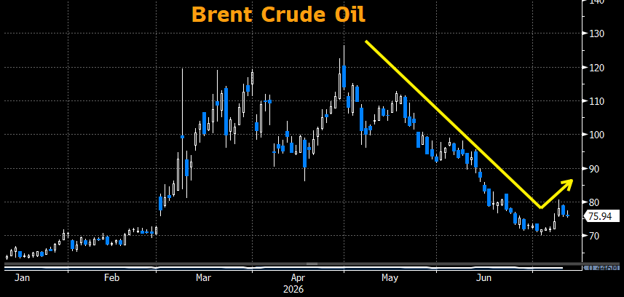
As has been the case throughout the conflict, the oil market remains the most immediate transmission mechanism into the broader economy. After retreating toward pre-conflict levels near $70 per barrel, Brent crude rallied more than 5% during the week and briefly traded above $80 per barrel as tensions escalated. While energy prices have since stabilized, it seems premature to assume a return to pre-war pricing. Until there is greater clarity surrounding the duration and scope of the conflict, oil markets are likely to maintain a geopolitical risk premium.
Interest rates responded accordingly. Treasury yields moved higher as investors reassessed inflation risks associated with rising energy prices. The 10-year Treasury yield pushed back above the important 4.50% threshold, while the 30-year Treasury briefly moved north of 5.00%. Once again, the market appears to be embracing a "higher-for-longer" interest rate environment as persistent inflation concerns continue to outweigh hopes for meaningful monetary easing.
Federal Reserve Chair Kevin Warsh will face his first Humphrey-Hawkins testimony before the House Financial Services Committee on Tuesday. While major policy surprises appear unlikely, the hearing will offer the first significant opportunity for lawmakers to question the new Chair regarding inflation, growth, labor market conditions, and the future direction of monetary policy. Investors should focus less on the political theater and more on any subtle clues regarding the Fed's tolerance for inflation and its willingness to keep policy restrictive.
Adding to the narrative, Federal Reserve Governor Christopher Waller reinforced the inflation message during remarks earlier this week. Waller noted that the labor market appears to be stabilizing while inflation has been "taking off," a notable shift from last year's concerns about employment weakness. His comments underscore a growing consensus within the Federal Reserve that price stability remains the primary objective. In short, the urgency to support employment has diminished while the determination to return inflation toward the Fed's 2% target remains intact.
Investors will have no shortage of economic data to digest in the days ahead. Tuesday's Consumer Price Index (CPI) report will be followed by Wednesday's Producer Price Index (PPI), both of which are expected to indicate some moderation in inflation pressures during June as energy prices eased prior to the recent escalation in Middle East tensions. Markets will also analyze the Fed's Beige Book, Retail Sales, and Housing Starts reports for evidence of whether economic growth remains resilient despite elevated borrowing costs.
Equity markets experienced a brief wobble last week before recovering their footing. Initial weakness stemmed from higher Treasury yields, renewed inflation concerns, and geopolitical uncertainty. However, the pullback proved short-lived as investors returned to the technology and artificial intelligence sectors, while optimism surrounding the upcoming earnings season helped support broader equity valuations. Once again, market leadership remains concentrated among growth-oriented sectors that continue to benefit from robust AI-related investment trends.
Looking ahead, the balance of risks remains tilted toward volatility. Geopolitical developments, inflation data, and Federal Reserve communication will likely dictate market direction through the heart of the summer. While the economy continues to demonstrate resilience, investors must remain mindful that reaccelerating inflation, elevated interest rates, and increasingly stretched equity valuations create the potential for periodic market setbacks. Those periods of weakness may ultimately provide more attractive opportunities for long-term capital deployment, but patience and risk management remain critical in an environment where uncertainty is once again taking center stage.
From the Municipal Desk
Contributions from Ryan Riffe
The municipal market suffered its weakest week since mid-May as benchmark yields moved higher across the curve, with increases of as much as eight basis points in certain maturities. The most notable weakness occurred in the intermediate and longer portions of the curve, while the front end remained relatively stable with yields rising just two basis points.
This move does not appear to reflect any sense of panic within the market, but rather what looks to be a potential summer reset. Ratios have steadily richened since late May and now sit below their one-year averages. While absolute yield levels remain attractive on a historical basis, this richer valuation backdrop may be creating a more selective environment for investors.
Despite the weakness in pricing, municipal bond funds recorded another strong week of inflows, exceeding $1 billion. The primary market also remained constructive, with most negotiated transactions receiving solid reception and competitive deals continuing to attract aggressive bidding.
Looking ahead, approximately $11 billion of new-issue supply is expected to come to market next week, modestly above the year-to-date weekly average of $10.2 billion. While strong reinvestment demand and continued fund inflows should provide a meaningful backstop, ongoing volatility in the Treasury market is likely to keep municipal investors cautious and attentive in the near term.
Weekly supply @ $11 Billion
Muni-Ratios Week Prior
2-YR Ratio @ 57% 2-YR Ratio @ 57%
3-YR Ratio @ 58% 3-YR Ratio @ 59%
5-YR Ratio @ 60% 5-YR Ratio @ 61%
10-YR Ratio @ 66% 10-YR Ratio @ 66%
30-YR Ratio @ 84% 30-YR Ratio @ 85%

An index is unmanaged and not available for direct investment. Definitions sourced from Bloomberg.
The Bloomberg Barclays Global Aggregate Negative Yielding Debt Market Value Index represents the portion of the Bloomberg Barclays Global Aggregate Index that measures the aggregate value of global debt with a negative yield. • The S&P 500® is widely regarded as the best single gauge of large-cap U.S. equities and serves as the foundation for a wide range of investment products. The index includes 500 leading companies and captures approximately 80% coverage of available market capitalization. • The NASDAQ Composite Index is a broad-based capitalization-weighted index of stocks in all three NASDAQ tiers: Global Select, Global Market and Capital Market. The index was developed with a base level of 100 as of February 5, 1971.• The Cboe Volatility Index® (VIX) is a calculation designed to produce a measure of constant, 30-day expected volatility of the US stock market, derived from real-time, mid-quote prices of weekly S&P 500® Index (SPX) call and put options with a range of 23 to 37 days to expiration.• The ICE BofA MOVE Index is a yield curve weighted index of the normalized implied volatility on 1-month Treasury options. It is the weighted average of implied volatilities on the CT2 (Current 2 Year Government Note), CT5 (Current 5 Year Government Note), CT10 (Current 10 Year Government Note), and CT30 (Current 30 Year Government Note), with weights 0.2/0.2/0.4/0.2 respectively.• The Markit CDX North America Investment Grade Index is composed of 125 equally weighted credit default swaps on investment grade entities, distributed among 6 sub-indices: High Volatility, Consumer, Energy, Financial, Industrial, and Technology, Media & Tele-communications. Markit CDX indices roll every 6 months in March & September. • The Markit CDX North America High Yield Index is composed of 100 non-investment grade entities, distributed among 2 sub-indices: B, BB. All entities are domiciled in North America. Markit CDX indices roll every 6 months in March & September. • The U.S. Dollar Index (USDX) indicates the general international value of the USD. The USDX does this by averaging the exchange rates between the USD and major world currencies. Intercontinental Exchange (ICE) US computes this by using the rates supplied by some 500 banks.
Investing involves certain risks, including possible loss of principal. You should understand and carefully consider a strategy’s objectives, risks, fees, expenses, and other information before investing. The views expressed in this commentary are subject to change and are not intended to be a recommendation or investment advice. Such views do not take into account the individual financial circumstances or objectives of any investor that receives them. All indices are unmanaged and are not available for direct investment. Indices do not incur costs including the payment of transaction costs, fees, and other expenses. This information should not be considered a solicitation or an offer to provide any service in any jurisdiction where it would be unlawful to do so under the laws of that jurisdiction. Past performance is no guarantee of future results.
© 2025 SWBC. All rights reserved. Securities offered through SWBC Investment Services, LLC, a registered broker/dealer. Member FINRA & SIPC. Advisory services offered through SWBC Investment Company, a Registered Investment Advisor, registered as such with the US Securities & Exchange Commission. SWBC Investment Services, LLC is under separate ownership from any other named entity. SWBC Investment Services, LLC a division of SWBC, is a nationwide partnership of advisor.

Let Us Know What You Thought about this Post.
Put your Comment Below.