
Rates Rip, Equities Slip: Duration Shock Triggers De-Risking Markets remained anchored to developments in the war with Iran throughout the week, with geopolitical risk continuing to drive macro sentim...
The evolving conflict with Iran remains the dominant force shaping market direction. Overnight on Tuesday, news that “peace may be breaking out in the Middle East” pressured Brent crude lower, briefly pushing prices below $100 per barrel before ending the week just modestly above that psychologically important level. U.S. officials continue to await Iran’s response to a proposed interim agreement aimed at de‑escalating the conflict. While acceptance of that proposal has limited directional market moves after the initial sharp move, intermittent flare‑ups in fighting underscore just how fragile the situation remains. Having witnessed too many false starts and premature declarations in prior episodes, I am not yet willing to take either side’s posturing at face value - this particular huckleberry will need clear, tangible evidence before being convinced the end is truly at hand.

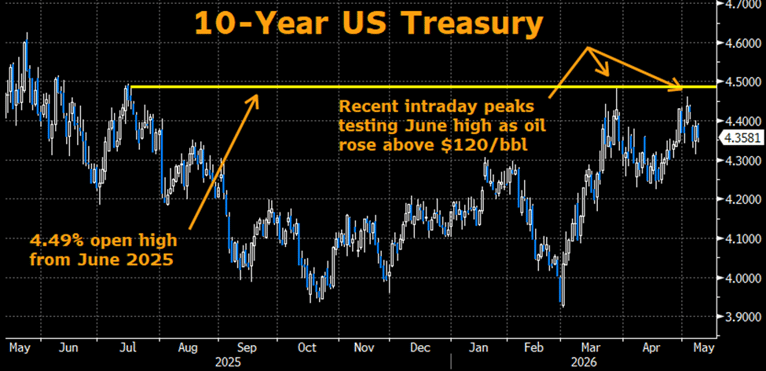
Interest rates remain elevated but pulled back from the prior week’s sharp surge in yields, which coincided with oil briefly peaking near $126 per barrel. The 10‑year Treasury settled around 4.36%, while the 30‑year bond crossed above 5% earlier in the week. The long bond, with its extended duration and risk profile, also reflects investor concern over rising federal borrowing requirements. Notably, U.S. debt‑to‑GDP exceeded 100% last week for the first time since World War II. The trajectory of the government owing more than it produces annually is a troubling long‑term dynamic and one that has concerned me for quite some time.
Markets briefly turned their attention to Friday morning’s monthly BLS employment report, which ultimately proved anticlimactic. Expectations were already subdued, as few believed labor data would eclipse the overriding narrative surrounding the Strait of Hormuz and its implications for global energy prices. Unsurprisingly, traders digested the report quickly, took a gulp of coffee, and refocused on geopolitical developments.
While bonds remain highly sensitive to oil price movements - exhibiting roughly a 75% directional correlation - equities have continued to carve out their own path. The S&P 500 advanced further, briefly surpassing the 7,400 level on Friday. The tech‑heavy Nasdaq 100 also pushed decisively higher, breaking above 29,000 with a gain of more than 5% on the week. Standout performance among technology names included some of my recent favorites, including Advanced Micro Devices (AMD) and Micron Technology (MU), both of which delivered notably strong results.
Looking ahead, markets continue to monitor the final procedural steps, including a Senate vote, in the confirmation of Kevin Warsh as the next Chair of the Federal Open Market Committee. In the interim, various Fed officials have been active in the media, with commentary largely focused on preparing to work under his leadership and acknowledging his forthcoming influence on the Committee. Across these remarks, there is broad consensus that the labor market remains relatively stable, while inflation risks command the majority of policymakers’ attention. Against this backdrop, maintaining a neutral policy stance appears appropriate as officials assess the downstream effects of elevated energy prices on domestic consumption and overall economic activity.
From a tactical standpoint, we focused on trading rates with one eye on geopolitical risk and the other on clearly defined technical levels. We looked to express views around price extremes, using support and resistance to frame risk. Early last week, a tactical long was established after the market tested and rejected the 4.45% level in 10‑year yields, offering an attractive risk‑reward setup. By Friday, that view had shifted. We initiated a short position in 10‑year futures as prices ran into well‑defined technical resistance, setting the stage for a potential retest of 4.45% in cash, particularly if progress toward peace with Iran continues to prove elusive.
From the Municipal Desk (with contributions from Ryan Riffe):
Municipals ended the week little changed, as the market largely shrugged off both geopolitical and economic headlines. With the new‑issue calendar rising to nearly $14 billion, investor attention shifted from the secondary to the primary market. Negotiated deals were well received and, in many cases, were not only repriced to lower yield targets but subsequently traded tighter in the secondary.
The bear‑flattening trend seen over the past several weeks was put on pause, as the front end of the Muni curve ended the week stronger by roughly 5 basis points. Inflows remain robust, with Lipper data reporting nearly $1.8 billion in municipal fund flows. While geopolitical developments will continue to influence market sentiment, we see a solid backstop in place as both fund flows and reinvestment capital remain strong. The market is expected to price approximately $12 billion of new‑issue supply next week, with San Francisco Airport, NY Dormitory Authority, and Atlanta Water/Wastewater revenue bonds among the largest offerings.
Weekly Supply @ $12 Billion
2-YR Ratio @ 63%
3-YR Ratio @ 63%
5-YR Ratio @ 65%
10-YR Ratio @ 68%
30-YR Ratio @ 87%

An index is unmanaged and not available for direct investment. Definitions sourced from Bloomberg.
The Bloomberg Barclays Global Aggregate Negative Yielding Debt Market Value Index represents the portion of the Bloomberg Barclays Global Aggregate Index that measures the aggregate value of global debt with a negative yield. • The S&P 500® is widely regarded as the best single gauge of large-cap U.S. equities and serves as the foundation for a wide range of investment products. The index includes 500 leading companies and captures approximately 80% coverage of available market capitalization. • The NASDAQ Composite Index is a broad-based capitalization-weighted index of stocks in all three NASDAQ tiers: Global Select, Global Market and Capital Market. The index was developed with a base level of 100 as of February 5, 1971.• The Cboe Volatility Index® (VIX) is a calculation designed to produce a measure of constant, 30-day expected volatility of the US stock market, derived from real-time, mid-quote prices of weekly S&P 500® Index (SPX) call and put options with a range of 23 to 37 days to expiration.• The ICE BofA MOVE Index is a yield curve weighted index of the normalized implied volatility on 1-month Treasury options. It is the weighted average of implied volatilities on the CT2 (Current 2 Year Government Note), CT5 (Current 5 Year Government Note), CT10 (Current 10 Year Government Note), and CT30 (Current 30 Year Government Note), with weights 0.2/0.2/0.4/0.2 respectively.• The Markit CDX North America Investment Grade Index is composed of 125 equally weighted credit default swaps on investment grade entities, distributed among 6 sub-indices: High Volatility, Consumer, Energy, Financial, Industrial, and Technology, Media & Tele-communications. Markit CDX indices roll every 6 months in March & September. • The Markit CDX North America High Yield Index is composed of 100 non-investment grade entities, distributed among 2 sub-indices: B, BB. All entities are domiciled in North America. Markit CDX indices roll every 6 months in March & September. • The U.S. Dollar Index (USDX) indicates the general international value of the USD. The USDX does this by averaging the exchange rates between the USD and major world currencies. Intercontinental Exchange (ICE) US computes this by using the rates supplied by some 500 banks.
Investing involves certain risks, including possible loss of principal. You should understand and carefully consider a strategy’s objectives, risks, fees, expenses, and other information before investing. The views expressed in this commentary are subject to change and are not intended to be a recommendation or investment advice. Such views do not take into account the individual financial circumstances or objectives of any investor that receives them. All indices are unmanaged and are not available for direct investment. Indices do not incur costs including the payment of transaction costs, fees, and other expenses. This information should not be considered a solicitation or an offer to provide any service in any jurisdiction where it would be unlawful to do so under the laws of that jurisdiction. Past performance is no guarantee of future results.
© 2025 SWBC. All rights reserved. Securities offered through SWBC Investment Services, LLC, a registered broker/dealer. Member FINRA & SIPC. Advisory services offered through SWBC Investment Company, a Registered Investment Advisor, registered as such with the US Securities & Exchange Commission. SWBC Investment Services, LLC is under separate ownership from any other named entity. SWBC Investment Services, LLC a division of SWBC, is a nationwide partnership of advisor.

Let Us Know What You Thought about this Post.
Put your Comment Below.