
Housing market fundamentals remain challenging, with affordability continuing to be the industry's primary hurdle as home prices remain elevated relative to household incomes and price-to-income ratio...
Key Highlights
- The Fed continued with its accommodative policy stance with two rate cuts totaling 50 basis points in the fourth quarter.
- The government shutdown disrupted both the economy and markets as a lack of available data kept investors guessing about the actual path for the economy.
- Equities kept advancing as new highs were reached and the AI trade dominated the market's collective conscience. Interest rates moved lower on the front-end on expectations of continued rate cuts
- “Low-Fire, Low Hire” labor situation essentially overshadowed concerns about inflation as the “K-shaped” economy separates high-income and low-income consumers.
Introduction
The fourth quarter of 2025 was dominated by the debate over the relative importance of persistently high inflation versus signs of a cooling labor market. Policy decisions from a divided Federal Reserve, which leaned toward accommodative rate cuts, signaled a clear preference for supporting employment over containing price pressures.
Preliminary estimates indicate that the U.S. economy continued to grow through year-end, while European economies experienced a more pronounced slowdown. In China, robust expansion earlier in the year gave way to structural challenges, particularly in real estate, despite fiscal stimulus and rate-cutting measures from Beijing.
Domestic growth was underpinned by resilient consumer spending; however, the K-shaped nature of the economy persisted. Higher-income households maintained strong consumption patterns, while lower-income consumers scaled back their spending.
The U.S. dollar stabilized but remained at relatively low levels amid dovish monetary policy, while precious metals - especially gold - surged. This rally was fueled by global central banks diversifying reserves away from dollar-denominated assets, heightened geopolitical uncertainty, and safe-haven flows. Additionally, the expansion of gold-backed ETFs added further demand, driving prices to recent highs above $4,500 per ounce.
In political developments, months of criticism from President Trump toward Jerome Powell intensified speculation over the next Federal Reserve Chair. Prediction markets narrowed the leading contenders to Kevin Hassett, Kevin Warsh, Christopher Waller, and Rick Rieder. Concerns about the Fed’s independence remain a key issue for market participants amid the contentious tone from the White House.
Equity markets were buoyed by the ongoing AI boom and related capital expenditures, which served as a primary catalyst for performance throughout the quarter. While questions about the sustainability of AI-driven gains occasionally surfaced, they had little lasting impact on overall market momentum.
The Economy: Shutdown Delays Data, But GDP Surprises to the Upside
The government shutdown created ripple effects for market participants who rely on timely economic data to guide investment decisions. Most notably, the release of official initial and secondary estimates for Real GDP was delayed by nearly two months. This postponement left investors grappling with uncertainty about the state of the economy well into the end of Q4.
When the Q3 data finally arrived in late December, it delivered a major surprise: Real GDP grew at an annualized rate of 4.3%, far exceeding consensus expectations of 2.0% to 2.5%. The upside surprise was driven by robust consumer spending, solid business investment, improved net exports, and increased government spending.
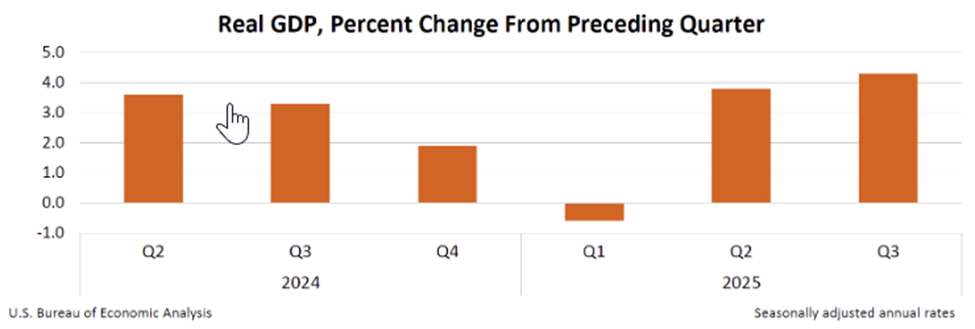
Despite this strong performance, far exceeding expert predictions for the quarter, forecasts for Q4 remain muted. Most estimates cluster near the low-2% range, with the Atlanta Fed’s GDPNow model projecting the most aggressive forecast at 2.7% annualized growth, signaling a slowdown from Q3’s rapid pace.
Net exports, which hit a historic low of –$1.264 trillion in Q1, improved for the second consecutive quarter in Q3, marking the most favorable reading since Q4 2020. Tariff-driven reductions in imports played a key role in this rebound.
Consumer resilience remained a cornerstone of economic strength, though spending patterns reflected the K-shaped economy. High-income households continued to spend, albeit with a more value-conscious approach, while lower-income consumers faced mounting debt and scaled back purchases as financial pressures intensified.
The Government Shutdown: Historic Shutdown Casts Long Shadow Over U.S. Economy
The United States endured its longest government shutdown in history, beginning October 1, 2025, and lasting 43 days until November 12. The full economic impact of this unprecedented disruption remains unclear, but its immediate consequences were significant.
The shutdown halted the release of critical economic indicators—including Nonfarm Payrolls, Unemployment, JOLTS, CPI, PPI, PCE, and Retail Sales—creating uncertainty and hesitation among market participants. Even after data releases resumed, doubts lingered about the true state of the economy.
Employment was notably affected, with an estimated 900,000 federal employees furloughed and more than 700,000 civilian employees impacted. In total, over 2.5 million workers either faced unpaid leave or worked without pay during the shutdown. Given the consumer-driven nature of the U.S. economy, these disruptions likely curtailed household spending as affected individuals adjusted to income shocks.
Macroeconomic consequences are still being assessed. Current estimates suggest each week of the shutdown shaved 0.1 to 0.2 percentage points off GDP growth. By that measure, Q4 GDP could be 0.6% to 1.2% lower than it otherwise would have been.
The Federal Reserve: Rate-Cutting Cycle Slows as Fed Balances Inflation and Jobs
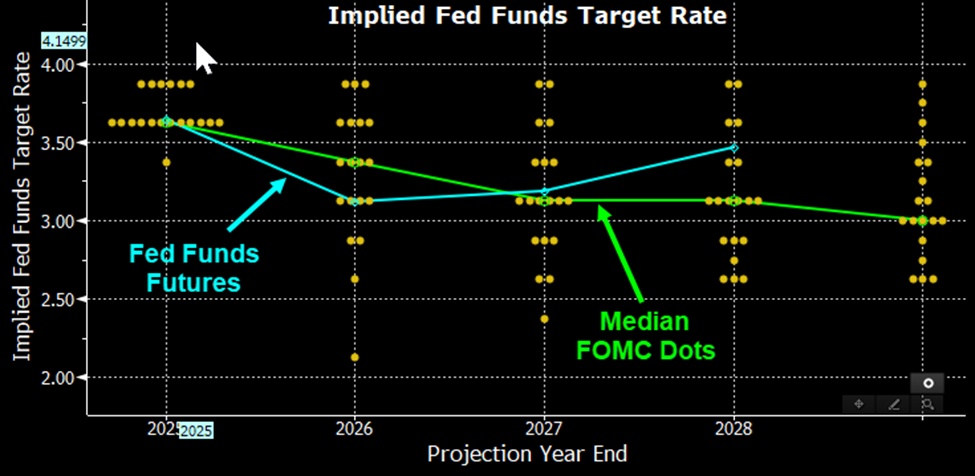
The Federal Open Market Committee (FOMC) extended its rate-cutting cycle in the fourth quarter, reducing the Fed Funds Target Rate by another 50 basis points. The target range now stands at 3.50%–3.75%, and markets anticipate a near-term pause in further policy adjustments.
Persistent divisions within the Committee highlighted the complexity of navigating the current economic environment. Policymakers remain split on the appropriate path forward, reflecting the ongoing tension between the Fed’s dual mandates—price stability and maximum employment.
 Source: Bloomberg
Adding to the uncertainty, political pressure intensified during the quarter. President Trump escalated criticism of Chair Jerome Powell, calling for more aggressive easing. Speculation about Powell’s potential replacement gained momentum, with names such as Kevin Hassett, Christopher Waller, Michelle Bowman, Kevin Warsh, and Rick Rieder appearing in headlines.
Looking ahead, the December Summary of Economic Projections (SEP), commonly referred to as the “Dot Plot,” indicates only one rate cut in 2026. Market expectations, however, diverge from this outlook, pricing in at least two cuts over the year. In the near term, Fed Funds futures suggest just a 15%–20% probability of a cut at the January meeting, reinforcing the likelihood of a pause.
The Labor Market: “Low-Hire, Low-Fire” Dynamic Clouds Employment Outlook
Concerns over a cooling labor market dominated the fourth quarter. Employment data, delayed by the government shutdown, revealed the highest unemployment rate since early 2021—rising to 4.6% in November. While Nonfarm Payrolls signaled slowing job creation, the labor market remains broadly within historical norms. Still, the “low-hire, low-fire” dynamic offers little reassurance about meaningful progress on employment.
Throughout the quarter, Fed officials debated the state of the labor market and its implications for policy. Those most concerned about underlying weakness argued for a more accommodative stance to support job growth.
Adding complexity, immigration policies under President Trump have likely contributed to labor force contraction, particularly in sectors such as agriculture, construction, hospitality, and caregiving.
Another emerging factor is the impact of AI-driven efficiencies on employment. Automation is reshaping roles in highly automatable fields—software development, customer service, clerical work, and legal services. Major companies, including Amazon, Microsoft, Salesforce, IBM, Intel, and UPS, have cited AI-related efficiencies as drivers of recent layoffs.
Inflation: Inflation Data Delays Cloud Q4 Economic Picture
Inflation data releases were disrupted during the fourth quarter due to delays in government reporting. The usual one-month lag for key indicators has yet to fully normalize, leaving some data incomplete. For example, October CPI was bundled with November figures and released in December, while the latest PCE report—released in early December—only covered data through September. We still await Q4 readings for this critical Fed-preferred metric.
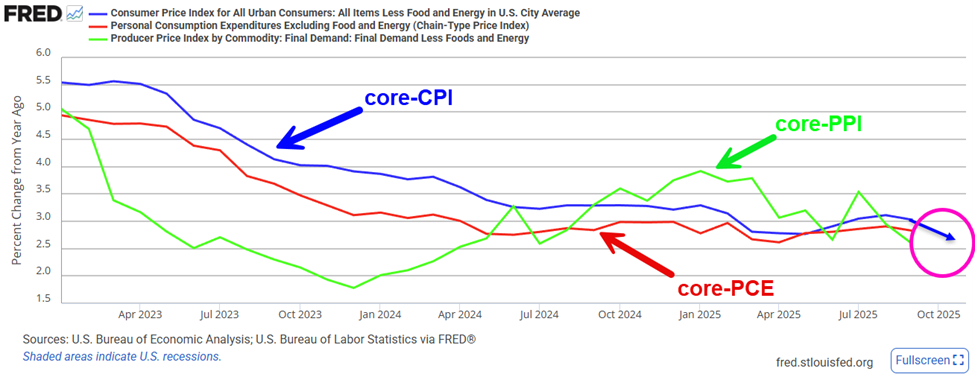
Despite progress earlier in the year, inflation remains stubbornly above the Fed’s 2% target. Core CPI for November registered at 2.6%, and additional data from PPI and PCE will be closely watched. Interestingly, tariffs that dominated headlines earlier in the year appear to have had little material impact on consumer prices.
The persistence of elevated inflation has deepened divisions within the Fed. Some policymakers remain concerned about the jobs situation, while others worry that efforts to stimulate the economy amid labor market cooling could reignite price growth -underscoring the delicate balance facing monetary policy.
The Housing Market: Existing Home Sales Remain Depressed Amid Affordability Strain
The U.S. housing market in 2025 continued to struggle under the weight of severe affordability constraints and historically low existing home sales. While some regions saw modest price corrections, home values remained elevated relative to income levels. Zillow reported that the national median home price sales hovered near $360,000, as wage growth slowed, thus widening the affordability gap. First-time buyers faced the greatest challenges, with down payment requirements and tighter credit standards adding to the strain.
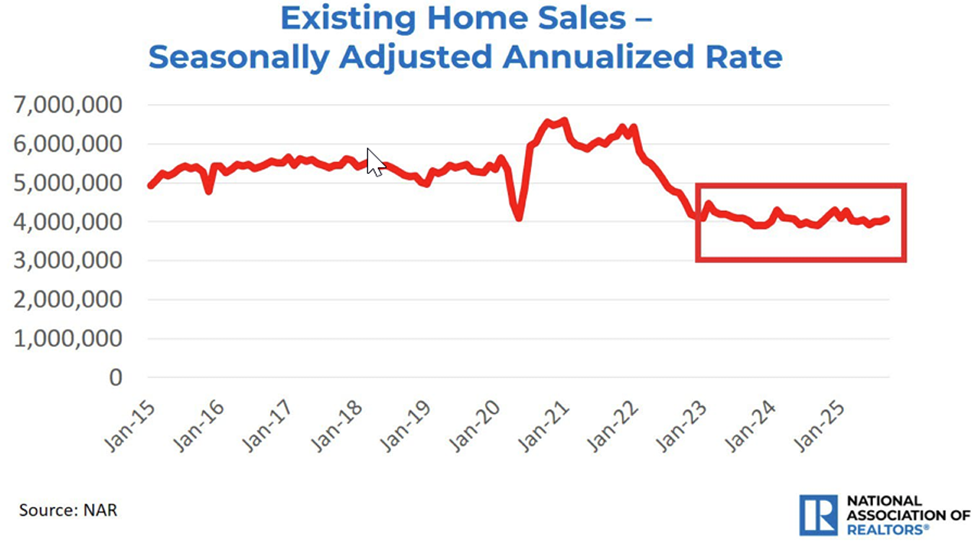
Mortgage rates remained stubbornly high for most of the year, with 30-Year Fixed Rates stuck between 6.5% and 7%, eventually declining closer to 6.25% after the Federal Reserve began cutting rates late in Q4. These still elevated rates reflected sticky inflation expectations and risk premiums in mortgage-backed securities markets. Higher borrowing costs significantly reduced purchasing power, forcing many buyers to either delay transactions or shift toward smaller homes and less competitive markets.
Home price dynamics varied sharply across geographies. Sun Belt markets in Texas, Arizona, and Florida generally either maintained stable prices or experienced modest price declines of 3–5% as pandemic-era demand cooled and inventory improved. Conversely, supply-constrained metropolitan areas, especially the greater New York City metropolitan area, maintained price resilience – even experiencing up to 3% price appreciation due to strong demand and limited land availability. Meanwhile, Midwest cities offered relative affordability, attracting migration from higher-cost coastal areas.
The combination of high mortgage rates, uneven price adjustments, and affordability stress weighed on residential investment, making home ownership a bigger challenge for hopeful new buyers. Construction activity slowed, particularly in single-family homes, while multi-family projects remained more robust due to rental demand. These dynamics underscore housing’s role as a key transmission channel for monetary policy and a critical determinant of consumer confidence heading into 2026.
The Consumer: Affluent Households Drive Spending as Lower-Income Consumers Struggle
The U.S. consumer landscape in 2025 revealed a stark divide. High-income households continued to propel economic activity, supported by strong asset values, steady employment in high-skill sectors, and easy access to credit. These consumers maintained robust spending on travel, luxury goods, and discretionary services, helping stabilize aggregate consumption. In contrast, lower-income households faced mounting pressure from elevated living costs, depleted pandemic-era savings, and tighter credit conditions - leading to cutbacks in non-essential purchases.
Persistent inflation in core services, such as housing, childcare, and healthcare, disproportionately impacted lower-income earners. While headline inflation moderated, essential expenses remained elevated, eroding real purchasing power. This divergence widened the gap between income cohorts, with lower-income consumers increasingly reliant on credit cards and buy-now-pay-later options, amplifying financial vulnerability.
Despite broader economic uncertainty, affluent households continued to support sectors like hospitality, technology, and premium retail. Their resilience reflected strong labor demand in high-skill industries and accumulated wealth from equity and real estate gains. This dynamic created a paradox: aggregate consumption appeared stable, yet underlying demand was concentrated among a relatively small segment of the population, masking stress in lower-income brackets.
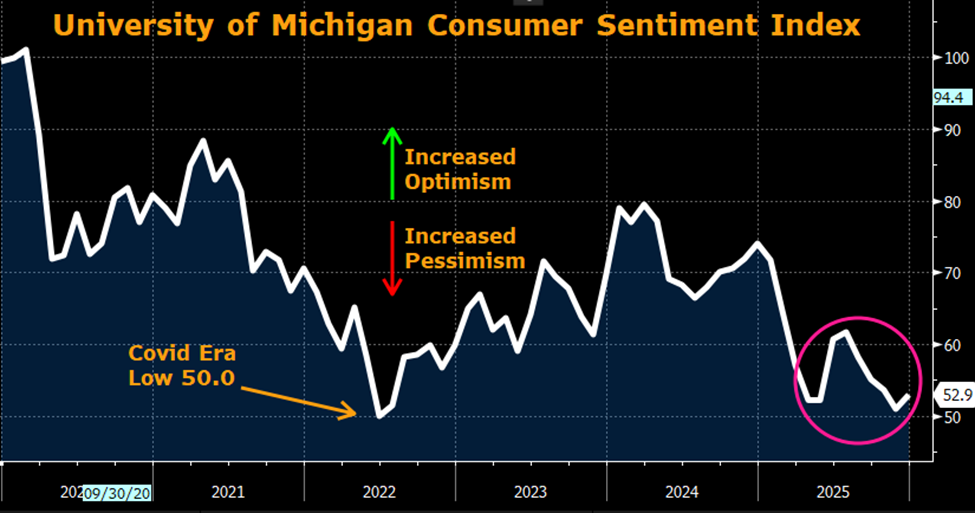
Consumer sentiment remained historically low throughout 2025, even as spending held up. Surveys revealed persistent pessimism tied to affordability concerns, political uncertainty, and lingering inflation anxiety. This disconnect underscores a critical nuance: while aggregate spending data suggests resilience, confidence indicators reflect deep unease among households, particularly those outside the top income tiers, raising questions about the sustainability of consumption heading into 2026.
Consumer Credit: Delinquency Rates Climb Amid Rising Credit Reliance
In 2025, U.S. consumer credit expanded at a faster pace than anticipated, driven largely by households attempting to maintain spending power despite persistent affordability challenges. Credit card balances and personal loans surged, particularly among lower-income and subprime borrowers who faced elevated costs for essentials such as housing, food, and healthcare. With real wage growth slowing and inflation in core services remaining sticky, many households turned to revolving credit as a bridge to sustain lifestyles that had become significantly more expensive.
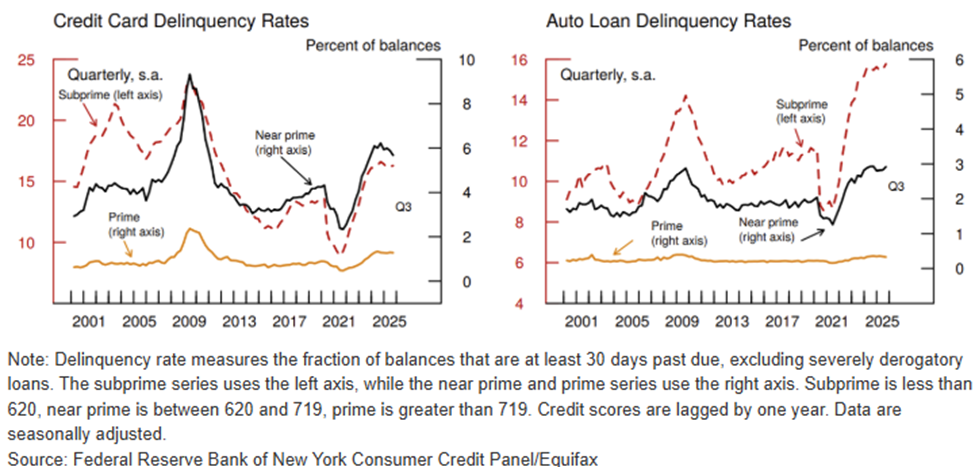
This increased reliance on borrowing has come at a cost. Delinquency rates on credit cards and auto loans climbed to multi-year highs, with subprime segments showing the sharpest deterioration. Rising interest rates earlier in the year compounded repayment burdens, while tighter liquidity left vulnerable borrowers exposed. The uptick in defaults and late payments signals mounting financial stress, raising concerns about spillover effects on consumer confidence and broader economic stability.
In response to rising credit risk, lenders tightened underwriting standards, reducing access to new credit for lower-income households even as demand for borrowing remained strong. This dynamic underscores a structural vulnerability: a significant portion of consumer spending is being propped up by debt rather than income growth. As inflation erodes purchasing power and wage gains fail to keep pace, the reliance on credit to sustain consumption poses long-term risks for both household balance sheets and aggregate demand heading into 2026
Interest Rates: Front-End Declines Contrast with Anchored Long-Term Yield
Throughout 2025, U.S. interest rates reflected a notable shift in monetary policy as the Federal Reserve revisited a more accommodative approach following 100 basis points of cuts in 2024. These actions contributed to a steepening trend in the yield curve, as short-term rates fell while long-term yields remained anchored, reflecting persistent structural risks.
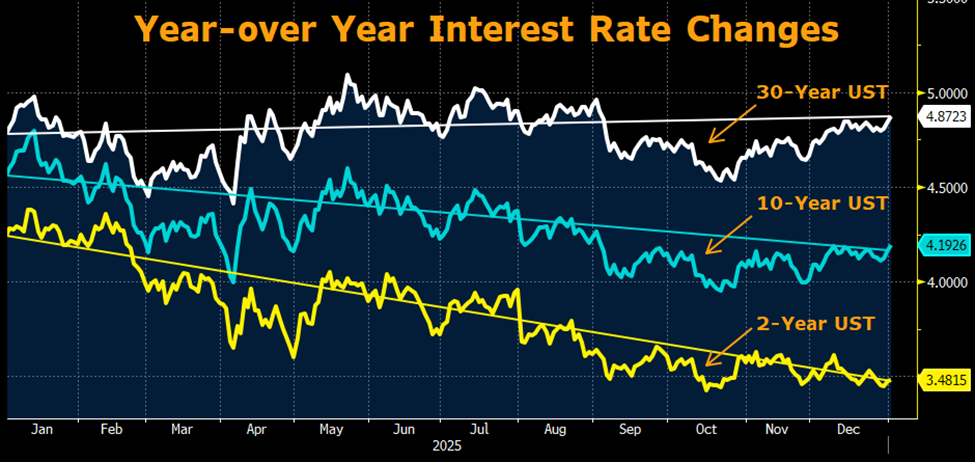
The steepening was primarily driven by the front end of the curve, where policy-sensitive maturities responded quickly to the Fed’s easing bias. Markets are pricing in expectations of additional cuts in 2026, pushing 2-year yields lower. In contrast, the long end of the curve, particularly the 30-year Treasury, remained stubbornly elevated, underscoring investor caution about long-term fiscal and inflationary pressures.
Despite progress on disinflation, core services inflation remained sticky near 2.8%, complicating the outlook for long-term price stability. Investors demanded a premium for holding longer-dated securities, wary that inflation could reaccelerate if policy easing proves premature. This inflation risk acted as a counterweight to the Fed’s dovish pivot, limiting downward movement in long-term yields.
The U.S. debt trajectory added another layer of complexity. With federal debt surpassing $34 trillion and interest costs consuming a growing share of the budget, concerns about fiscal sustainability kept term premiums elevated. The market’s reluctance to bid down 30-year yields reflects skepticism about long-run debt management and the potential for higher issuance to fund persistent deficits.
The resulting curve steepening signals a nuanced environment: near-term monetary easing supports liquidity and growth, while structural inflation and fiscal risks anchor long-term rates. For investors, this dynamic favors strategies that exploit front-end rate declines while hedging duration risk. For policymakers, it underscores the challenge of balancing short-term economic support with long-term credibility, a tension likely to shape rate expectations well into 2026.
The Equity Market: New Highs and Continued Strength
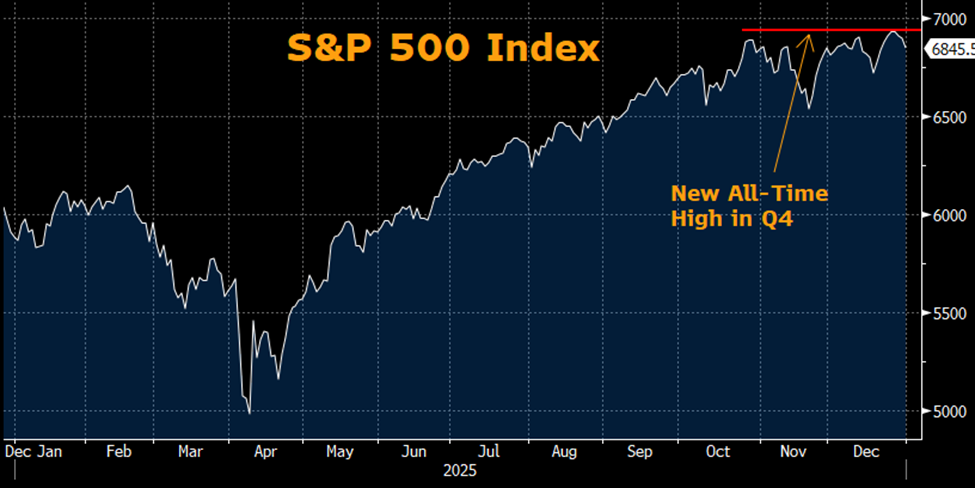
Equities continued to climb to record levels in the fourth quarter, with the S&P 500 closing just above 6,850, capping a nearly 16% return following the previous 2 years of nearly 25% returns. Despite headwinds, the market demonstrated incredible resilience, supported by robust earnings growth. Lingering concerns about stretched valuations, macroeconomic uncertainty, and technical factors persisted, but a pullback failed to materialize.
Source: Bloomberg
AI and technology stocks were the primary catalyst for the continued strong performance. Capital expenditures in AI infrastructure and services fueled much of the performance not only in the Magnificent 7 but the broader market as well. Adoption of AI-related processes among companies in a variety of industries helped improve efficiencies and margins, expanding equity performance beyond the technology stocks investing heavily in chips and data centers.
Investors rotated into cyclical and industrial growth stocks as easier monetary policy helped performance, and late-quarter resilience hinted at a modest broadening beyond the mega-cap tech stocks. International and emerging markets posted strong relative performance, likely benefiting from a weaker dollar and solid economic momentum.
2026 Outlook
We enter 2026 amid uncertainty as investors seek clarity on delayed and questionable economic data. My base-case GDP forecast calls for +2.3% growth, supported by easing financial conditions, diminished tariff concerns, continued AI-driven investment, and pro-growth policies that create room for expansion.
With recession risk low, accommodative Fed policy and resilient consumer spending underpin my expectation for a soft landing. However, the threat of stagflation cannot be dismissed. The fragile labor market and persistent inflationary pressures demand vigilance as we monitor signs of stress.
On monetary policy, I anticipate two additional rate cuts in 2026, despite the Fed’s Dot Plot signaling only one. While inflation remains elevated, I expect dovish voices to prevail, pushing for a more accommodative stance. This shift reflects a new era for the FOMC - greater internal division and continued dissents on interest rate decisions. While different from its traditional outward persona, such discord ultimately strengthens its independence and credibility.
Rates should continue to decline at the short end of the curve, while long-term yields remain stubbornly high, sustaining a steep curve. With much of the steepening already realized, further moves will be limited. Though benchmark 10-Year Treasury yields may test lower yields near the 3.50% area, it will be difficult to push meaningfully lower with inflation continuing to be a concern and an anticipated floor in short-term rates near 3%. Thus, mortgage rates are unlikely to see meaningful relief with 30-year fixed rate levels failing to decline below 5.50%, leaving housing affordability under pressure.
Equities closed last year near my 7,000 S&P 500 target. Looking ahead, I expect another year of gains, driven by AI investment, and forecast a 7,700 target for 2026, implying roughly +10% returns. I remain wary of any meaningful pull-back in equities at some point during the year, but ultimately any such events should be considered a dip-buying opportunity for investors with a longer-term investment horizon.
Unforeseen risks—the classic ‘unknown unknowns’—remain a concern for both the economy and markets. While geopolitical shocks and shifting tariff dynamics warrant ongoing attention, the possibility of an unexpected event triggering market anxiety and adverse reactions cannot be overlooked.


Let Us Know What You Thought about this Post.
Put your Comment Below.