
Housing market fundamentals remain challenging, with affordability continuing to be the industry's primary hurdle as home prices remain elevated relative to household incomes and price-to-income ratio...
Markets Anticipated a Nothing-Burger, Got Much More with Extra Pickles
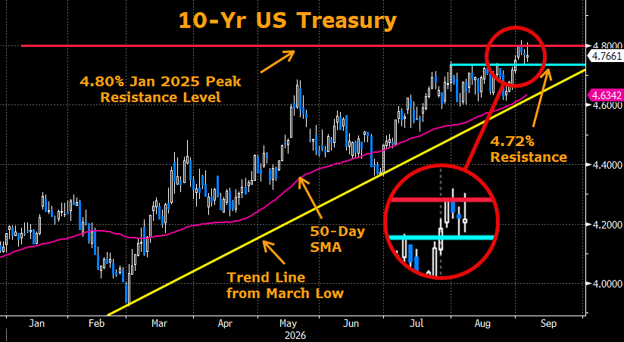
Following Chair Warsh's inaugural Jackson Hole address, investors spent much of last week digesting a message centered on inflation discipline and the Federal Reserve's commitment to restoring inflation to its 2% PCE target. Markets interpreted the speech as distinctly hawkish, pushing Treasury yields steadily higher throughout the week. Most notably, the benchmark 10-Year Treasury yield broke decisively above the 4.72% level that had capped rates throughout much of July and August before testing the important 4.80% area, a level not seen since the January 2025 peak.
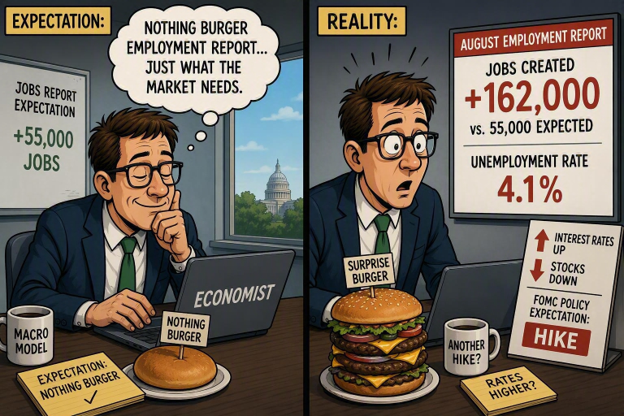
 As the Labor Day weekend approached, investors turned their attention to the monthly employment report. Expectations were decidedly muted. Consensus forecasts called for just 55,000 new jobs, reflecting a broad belief that the labor market was stable and unlikely to generate a meaningful market reaction. In other words, traders were expecting a classic "nothing burger" payroll report.
Instead, the labor market delivered a triple-decker with all the fixings.
Nonfarm payrolls increased by 162,000 jobs, nearly triple expectations, while the unemployment rate held steady at 4.1%.
The report reinforced Warsh's characterization of a labor market that remains relatively healthy and broadly consistent with full employment. More importantly, it challenged the prevailing narrative that economic growth was weakening sufficiently to remove concerns about inflation persistence.
Fed Governor Waller, one of the Federal Reserve's more dovish voices, stated last week that he would support holding rates steady should upcoming inflation data fail to show signs of renewed price pressures. Markets nevertheless expect hawkish dissenters including Hammack, Kashkari, and Logan to continue advocating for tighter policy. By Friday's close, Fed Funds futures reflected growing concern that another rate increase remains possible, with implied hike probabilities increasing from approximately 51% before the payroll report to roughly 62% afterward.
My concern remains that the Federal Reserve is running short on runway if Chair Warsh is serious about returning inflation to the 2% target within a reasonable time frame.
Markets increasingly question whether policymakers possess both the willingness and the resolve to take unpopular actions if inflation proves sticky. The longer inflation remains above target, the greater the risk that policy credibility becomes part of the problem.
Equity markets spent the week oscillating between optimism regarding economic growth and concern regarding higher interest rates. The S&P 500 finished little changed on the week and remains trapped in the broad 7,600 to 7,800 trading range that has defined price action since mid-August. While the AI-related technology trade continues to provide support for broader market valuations, higher rates have begun to temper some of the enthusiasm. Investors remain divided as to whether elevated capital spending on artificial intelligence represents a sustainable growth opportunity or simply an increasingly expensive justification for higher share prices.
With the 10-Year Treasury now consolidating near 4.80%, the next important question is whether yields ultimately break through to reach the psychologically significant 5.00% threshold.
Based on a combination of technical and fundamental considerations, I continue to believe that the path forward for interest rates remains higher. The market entered last week expecting a pedestrian employment report. Instead, the labor market delivered a reminder that the economy may be stronger, and inflation pressures more persistent, than many investors would prefer.
From the Municipal Desk
Contributions from Ryan Riffe
The municipal market remained under pressure last week, driving the 10-Year M/T ratio to approximately 73%, its cheapest level since September 2025. Rising concerns surrounding the expanding national debt burden, coupled with inflation risks tied to energy markets and ongoing geopolitical tensions, pushed the benchmark 10-Year U.S. Treasury yield to 4.80%, a level not seen since early 2025.
Municipal bonds have struggled to withstand the broader rise in interest rates as record levels of new issuance continue to come to market. Despite the challenging backdrop, both negotiated and competitive transactions have generally been well received, with many deals heavily oversubscribed and repriced to lower yields during the order period. The sheer volume of primary issuance has largely captured investor attention, however, leaving secondary market activity relatively subdued as buyers focus on the concessions available in the new issue market.
Looking ahead, pressure on municipal valuations may persist. More than $15 billion of new issuance is expected to be priced during the abbreviated holiday week, while investors also contend with a closely watched inflation report that could influence both Treasury yields and Federal Reserve expectations. Against a backdrop of elevated supply and upward pressure on rates, the municipal market may continue to face near-term headwinds.
Muni-Ratios

An index is unmanaged and not available for direct investment. Definitions sourced from Bloomberg.
The Bloomberg Barclays Global Aggregate Negative Yielding Debt Market Value Index represents the portion of the Bloomberg Barclays Global Aggregate Index that measures the aggregate value of global debt with a negative yield. • The S&P 500® is widely regarded as the best single gauge of large-cap U.S. equities and serves as the foundation for a wide range of investment products. The index includes 500 leading companies and captures approximately 80% coverage of available market capitalization. • The NASDAQ Composite Index is a broad-based capitalization-weighted index of stocks in all three NASDAQ tiers: Global Select, Global Market and Capital Market. The index was developed with a base level of 100 as of February 5, 1971.• The Cboe Volatility Index® (VIX) is a calculation designed to produce a measure of constant, 30-day expected volatility of the US stock market, derived from real-time, mid-quote prices of weekly S&P 500® Index (SPX) call and put options with a range of 23 to 37 days to expiration.• The ICE BofA MOVE Index is a yield curve weighted index of the normalized implied volatility on 1-month Treasury options. It is the weighted average of implied volatilities on the CT2 (Current 2 Year Government Note), CT5 (Current 5 Year Government Note), CT10 (Current 10 Year Government Note), and CT30 (Current 30 Year Government Note), with weights 0.2/0.2/0.4/0.2 respectively.• The Markit CDX North America Investment Grade Index is composed of 125 equally weighted credit default swaps on investment grade entities, distributed among 6 sub-indices: High Volatility, Consumer, Energy, Financial, Industrial, and Technology, Media & Tele-communications. Markit CDX indices roll every 6 months in March & September. • The Markit CDX North America High Yield Index is composed of 100 non-investment grade entities, distributed among 2 sub-indices: B, BB. All entities are domiciled in North America. Markit CDX indices roll every 6 months in March & September. • The U.S. Dollar Index (USDX) indicates the general international value of the USD. The USDX does this by averaging the exchange rates between the USD and major world currencies. Intercontinental Exchange (ICE) US computes this by using the rates supplied by some 500 banks.
Investing involves certain risks, including possible loss of principal. You should understand and carefully consider a strategy’s objectives, risks, fees, expenses, and other information before investing. The views expressed in this commentary are subject to change and are not intended to be a recommendation or investment advice. Such views do not take into account the individual financial circumstances or objectives of any investor that receives them. All indices are unmanaged and are not available for direct investment. Indices do not incur costs including the payment of transaction costs, fees, and other expenses. This information should not be considered a solicitation or an offer to provide any service in any jurisdiction where it would be unlawful to do so under the laws of that jurisdiction. Past performance is no guarantee of future results.
© 2025 SWBC. All rights reserved. Securities offered through SWBC Investment Services, LLC, a registered broker/dealer. Member FINRA & SIPC. Advisory services offered through SWBC Investment Company, a Registered Investment Advisor, registered as such with the US Securities & Exchange Commission. SWBC Investment Services, LLC is under separate ownership from any other named entity. SWBC Investment Services, LLC a division of SWBC, is a nationwide partnership of advisor.
Let Us Know What You Thought about this Post.
Put your Comment Below.