
Bond Investors Experience Another Splashdown Bond investors endured another stomach-turning trip down the flume this past week as persistent inflation concerns and elevated yields kept pressure square...
A Sober Verdict on a Hawkish Fed
Interest rates reached their highest levels in nearly two decades ahead of last week's highly anticipated FOMC meeting, where policymakers unanimously approved a 25-basis-point rate increase. Both the official statement and Chair Warsh's press conference conveyed a distinctly hawkish message. While Warsh attempted to avoid explicit forward guidance, the Summary of Economic Projections effectively spoke for itself, with twelve committee members anticipating one additional rate hike this year and four expecting two more.
Two important byproducts emerged from the decision. First, the Federal Reserve reaffirmed its institutional independence. Second, it reinforced its inflation-fighting credibility.
Prior to the meeting, reasonable questions existed regarding both. Following the announcement, market participants were left with little doubt that controlling inflation remains the Committee's primary objective, even at the expense of slower economic growth or increased market volatility.
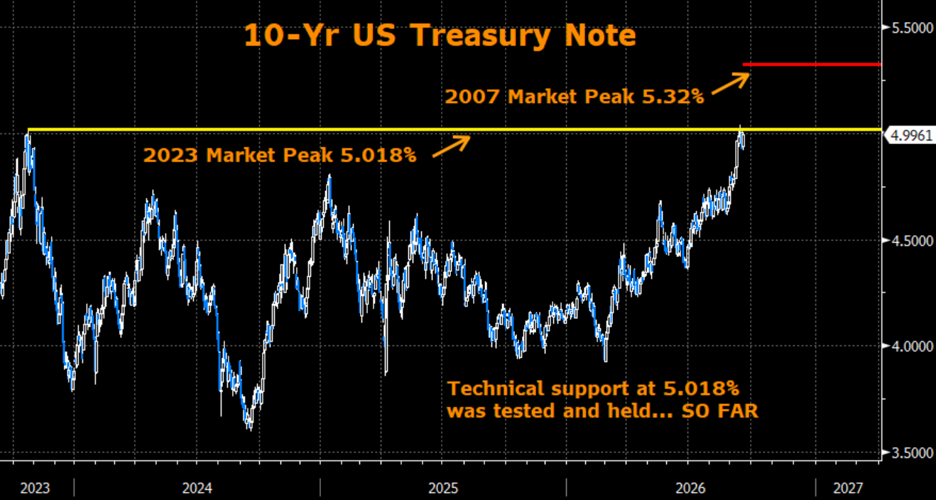 Perhaps the most notable development was not the rate hike itself, but the market's remarkably sober reaction to it. Despite a hawkish policy decision, a hawkish SEP, and a hawkish press conference, markets largely absorbed the news without disorder. Rather than triggering a significant risk-off event, investors appeared willing to accept the Committee's message and recalibrate expectations accordingly.
Treasury yields remained elevated throughout the remainder of the week, with the benchmark 10-Year Treasury ending near 4.99%, just shy of the psychologically significant 5% threshold and only modestly below the 2023 high of 5.018%. Meanwhile, the oil market paused following its earlier advance driven by geopolitical concerns, including threats against Saudi infrastructure and ongoing Middle East tensions. Although crude retreated from nearly $110 per barrel, prices remain firmly above $100, continuing to complicate the inflation outlook.
Another constructive outcome was the reduction in uncertainty surrounding the Warsh-led FOMC's reaction function.
Throughout much of the summer, investors struggled to determine how policymakers would respond to inflation surprises, market volatility, or slowing economic growth. While market participants may not welcome every decision, a predictable central bank is generally preferable to an unpredictable one. Last week's meeting provided valuable insight into the Committee's priorities and decision-making framework.
Equity markets reflected that measured response. The S&P 500 briefly flirted with the 7,500 level before recovering to finish the week little changed. While investors continue to weigh the implications of higher borrowing costs and the potential for slower economic growth, there was little evidence of panic. Instead, markets appeared to acknowledge that tighter monetary policy is now the unavoidable cost of restoring price stability.
Chair Warsh could not have been clearer regarding the Committee's priorities. Inflation remains too high, and restoring price stability remains the Fed's central mission.
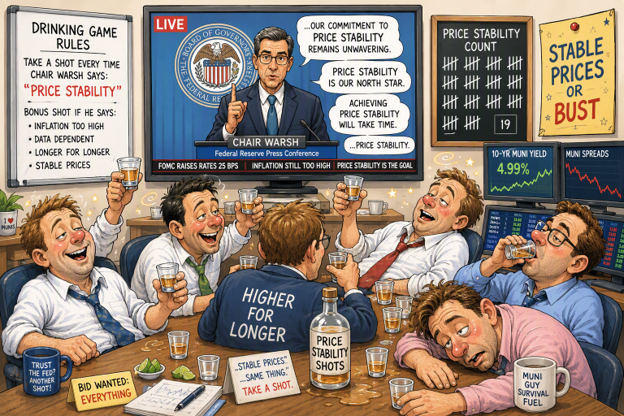
After watching the press conference, I analyzed the transcript using AI to determine how frequently "stable prices" and "price stability" appeared in both the statement and subsequent remarks. The tally approached twenty references during a relatively brief half-hour period. Had one been playing a college-style drinking game based on those phrases, the evening would have ended well before the workday did. More importantly, however, the exercise underscored a serious point: this Federal Reserve is signaling repeatedly that it is willing to make difficult and unpopular decisions in pursuit of restoring purchasing power and controlling inflation.
 Looking ahead, the combination of a higher-for-longer interest-rate environment, moderating economic growth, and still-elevated inflation pressures leads me to believe that this cycle's peak in interest rates has not yet been reached. As a result, I expect the 2007 high of 5.32% on the benchmark 10-Year Treasury Note to come back into view in the months ahead.
On equities, while my year-end target of 7,700 for the S&P 500 has already been achieved, I continue to expect more limited upside from current levels near 7,650.
Slower economic conditions, tighter financial conditions, and the potential for periodic market pullbacks suggest that gains beyond the 7,800 area may prove increasingly difficult to sustain. The market's recent resilience has been impressive, but investors should not mistake a sober reaction to a hawkish Fed for an all-clear signal. The medicine may have been accepted, but the treatment is not yet complete.
From the Municipal Desk
Contributions from Ryan Riffe
The roller coaster ride for municipals continued last week, with volatility once again taking center stage. Echoing the sharp moves seen across the Treasury market, the municipal yield curve experienced a significant flattening as fixed-income investors digested a hawkish Federal Reserve and its first interest rate hike in three years. By Friday's close, benchmark municipal yields had risen more than 20 basis points across front-end maturities, while longer-dated bonds in the 25- to 30-year portion of the curve were largely unchanged.
Sticky inflation, elevated energy prices, and resilient consumer spending have continued to unnerve global bond markets as investors attempt to determine what this new rate-hiking cycle ultimately looks like.
For municipal investors, rate volatility and a steady barrage of new issuance have remained persistent headwinds since mid-July.
Adding to the challenge last week were approximately $1.8 billion of municipal fund outflows and a year-to-date record level of bid-wanted activity, further highlighting the cautious tone permeating the market. With technical conditions having stalled for more than a month and new issue calendars showing little sign of slowing, municipal investors have yet to receive the relief that would typically accompany periods of elevated yields.
While higher yields have created increasingly attractive entry points for long-term investors, the municipal market remains caught between improving valuations and stubbornly unfavorable technicals. Until supply moderates, fund flows stabilize, and investors gain greater confidence in the ultimate destination of Fed policy, volatility is likely to remain a defining feature of the market rather than a temporary distraction.
Muni-Ratios

An index is unmanaged and not available for direct investment. Definitions sourced from Bloomberg.
The Bloomberg Barclays Global Aggregate Negative Yielding Debt Market Value Index represents the portion of the Bloomberg Barclays Global Aggregate Index that measures the aggregate value of global debt with a negative yield. • The S&P 500® is widely regarded as the best single gauge of large-cap U.S. equities and serves as the foundation for a wide range of investment products. The index includes 500 leading companies and captures approximately 80% coverage of available market capitalization. • The NASDAQ Composite Index is a broad-based capitalization-weighted index of stocks in all three NASDAQ tiers: Global Select, Global Market and Capital Market. The index was developed with a base level of 100 as of February 5, 1971.• The Cboe Volatility Index® (VIX) is a calculation designed to produce a measure of constant, 30-day expected volatility of the US stock market, derived from real-time, mid-quote prices of weekly S&P 500® Index (SPX) call and put options with a range of 23 to 37 days to expiration.• The ICE BofA MOVE Index is a yield curve weighted index of the normalized implied volatility on 1-month Treasury options. It is the weighted average of implied volatilities on the CT2 (Current 2 Year Government Note), CT5 (Current 5 Year Government Note), CT10 (Current 10 Year Government Note), and CT30 (Current 30 Year Government Note), with weights 0.2/0.2/0.4/0.2 respectively.• The Markit CDX North America Investment Grade Index is composed of 125 equally weighted credit default swaps on investment grade entities, distributed among 6 sub-indices: High Volatility, Consumer, Energy, Financial, Industrial, and Technology, Media & Tele-communications. Markit CDX indices roll every 6 months in March & September. • The Markit CDX North America High Yield Index is composed of 100 non-investment grade entities, distributed among 2 sub-indices: B, BB. All entities are domiciled in North America. Markit CDX indices roll every 6 months in March & September. • The U.S. Dollar Index (USDX) indicates the general international value of the USD. The USDX does this by averaging the exchange rates between the USD and major world currencies. Intercontinental Exchange (ICE) US computes this by using the rates supplied by some 500 banks.
Investing involves certain risks, including possible loss of principal. You should understand and carefully consider a strategy’s objectives, risks, fees, expenses, and other information before investing. The views expressed in this commentary are subject to change and are not intended to be a recommendation or investment advice. Such views do not take into account the individual financial circumstances or objectives of any investor that receives them. All indices are unmanaged and are not available for direct investment. Indices do not incur costs including the payment of transaction costs, fees, and other expenses. This information should not be considered a solicitation or an offer to provide any service in any jurisdiction where it would be unlawful to do so under the laws of that jurisdiction. Past performance is no guarantee of future results.
© 2025 SWBC. All rights reserved. Securities offered through SWBC Investment Services, LLC, a registered broker/dealer. Member FINRA & SIPC. Advisory services offered through SWBC Investment Company, a Registered Investment Advisor, registered as such with the US Securities & Exchange Commission. SWBC Investment Services, LLC is under separate ownership from any other named entity. SWBC Investment Services, LLC a division of SWBC, is a nationwide partnership of advisor.
Let Us Know What You Thought about this Post.
Put your Comment Below.