
Bond Investors Experience Another Splashdown Bond investors endured another stomach-turning trip down the flume this past week as persistent inflation concerns and elevated yields kept pressure square...
Rates, Oil, and AI: Markets are at an Inflection Point
During the early part of last week, market participants were primarily focused on digesting the implications of the prior week’s FOMC meeting. The Committee’s hawkish pause effectively upended the prevailing rate-cut narrative, prompting several economists to revise their forecasts to include as many as three rate cuts by year-end.
On Wednesday, the closely watched Personal Consumption Expenditures (PCE) report - the Fed’s preferred inflation gauge under the prior regime - reinforced the “higher-for-longer” rate outlook. While the data came in line with expectations, at 4.1% for headline PCE and 3.4% for core PCE, both readings remain near multi-year highs, underscoring the persistence of inflationary pressures.
Meanwhile, the reopening of the Strait of Hormuz has driven Brent crude prices down toward pre-war levels. However, Iran has issued conflicting statements suggesting the strait remains closed and has, at a minimum, disrupted traffic in recent days. Transit volumes are estimated to be operating at less than 50% of full capacity. As a result, the key question for oil markets is whether lower prices are sustainable and how quickly normal production and distribution channels can be restored.
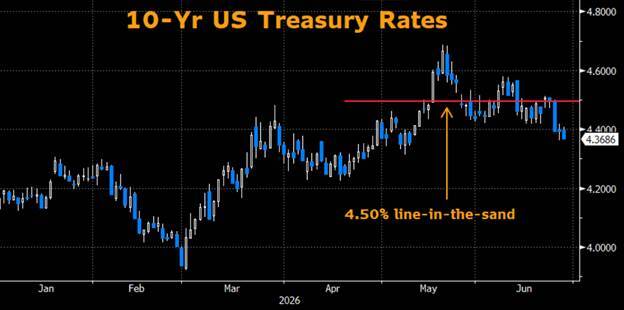
Interest rates have decoupled from their previously tight correlation with oil prices and remain elevated relative to pre-war levels, despite the decline in crude. That said, yields have recently moved below the critical 4.50% threshold - a level that has historically served as an important demarcation point, above which equity valuations tend to come under greater pressure.
Lastly, the AI-driven momentum that has powered equity markets for much of the year appears to be shifting into a lower gear. While the underlying investment in AI infrastructure remains robust, the equity trade has become more selective, with valuation discipline taking on increased importance amid elevated technology sector pricing. A seasonal slowdown over the summer months is possible, which could present investors with a more attractive opportunity to re-engage at lower levels.
Looking ahead, I remain somewhat on the fence about forecasting a rate hike later this year, as it appears that the worst of the war-driven inflationary pressures are likely behind us. That said, I do not believe current policy is sufficiently restrictive. Should we see further improvement in labor market data, the case for an additional rate hike would strengthen. As a result, I will defer to what I view as the more justified policy path and incorporate a rate hike into my year-end outlook.
From the Municipal Desk (with contributions from Ryan Riffe):
Last week was relatively quiet for municipals, with benchmark yields fluctuating. The muni curve flattened over the course of the week, as interest in intermediate and longer maturities outweighed demand on the front end. Secondary trading activity was heavier in longer durations, while negotiated deals were heavily oversubscribed in similar tenors. Although down from last week’s figure, Lipper reported $633 million of weekly inflows into muni bond funds. This marks thirteen consecutive weeks of inflows, with nearly half of those exceeding $1 billion.
With only three and a half trading days next week, the market is expected to price roughly $4 billion of new issuance, which should be well received given the significantly higher year-to-date weekly average of $10.5 billion. Absolute yields and ratios continue to look attractive, while reinvestment capital and fund flows remain robust. These positive undertones should help the market maintain solid momentum as we head into July.
Weekly supply @ $4 Billion
Muni-Ratios Week Prior
2-YR Ratio @ 58% 2-YR Ratio @ 59%
3-YR Ratio @ 60% 3-YR Ratio @ 61%
5-YR Ratio @ 63% 5-YR Ratio @ 63%
10-YR Ratio @ 68% 10-YR Ratio @ 67%
30-YR Ratio @ 87% 30-YR Ratio @ 87%

An index is unmanaged and not available for direct investment. Definitions sourced from Bloomberg.
The Bloomberg Barclays Global Aggregate Negative Yielding Debt Market Value Index represents the portion of the Bloomberg Barclays Global Aggregate Index that measures the aggregate value of global debt with a negative yield. • The S&P 500® is widely regarded as the best single gauge of large-cap U.S. equities and serves as the foundation for a wide range of investment products. The index includes 500 leading companies and captures approximately 80% coverage of available market capitalization. • The NASDAQ Composite Index is a broad-based capitalization-weighted index of stocks in all three NASDAQ tiers: Global Select, Global Market and Capital Market. The index was developed with a base level of 100 as of February 5, 1971.• The Cboe Volatility Index® (VIX) is a calculation designed to produce a measure of constant, 30-day expected volatility of the US stock market, derived from real-time, mid-quote prices of weekly S&P 500® Index (SPX) call and put options with a range of 23 to 37 days to expiration.• The ICE BofA MOVE Index is a yield curve weighted index of the normalized implied volatility on 1-month Treasury options. It is the weighted average of implied volatilities on the CT2 (Current 2 Year Government Note), CT5 (Current 5 Year Government Note), CT10 (Current 10 Year Government Note), and CT30 (Current 30 Year Government Note), with weights 0.2/0.2/0.4/0.2 respectively.• The Markit CDX North America Investment Grade Index is composed of 125 equally weighted credit default swaps on investment grade entities, distributed among 6 sub-indices: High Volatility, Consumer, Energy, Financial, Industrial, and Technology, Media & Tele-communications. Markit CDX indices roll every 6 months in March & September. • The Markit CDX North America High Yield Index is composed of 100 non-investment grade entities, distributed among 2 sub-indices: B, BB. All entities are domiciled in North America. Markit CDX indices roll every 6 months in March & September. • The U.S. Dollar Index (USDX) indicates the general international value of the USD. The USDX does this by averaging the exchange rates between the USD and major world currencies. Intercontinental Exchange (ICE) US computes this by using the rates supplied by some 500 banks.
Investing involves certain risks, including possible loss of principal. You should understand and carefully consider a strategy’s objectives, risks, fees, expenses, and other information before investing. The views expressed in this commentary are subject to change and are not intended to be a recommendation or investment advice. Such views do not take into account the individual financial circumstances or objectives of any investor that receives them. All indices are unmanaged and are not available for direct investment. Indices do not incur costs including the payment of transaction costs, fees, and other expenses. This information should not be considered a solicitation or an offer to provide any service in any jurisdiction where it would be unlawful to do so under the laws of that jurisdiction. Past performance is no guarantee of future results.
© 2025 SWBC. All rights reserved. Securities offered through SWBC Investment Services, LLC, a registered broker/dealer. Member FINRA & SIPC. Advisory services offered through SWBC Investment Company, a Registered Investment Advisor, registered as such with the US Securities & Exchange Commission. SWBC Investment Services, LLC is under separate ownership from any other named entity. SWBC Investment Services, LLC a division of SWBC, is a nationwide partnership of advisor.
Let Us Know What You Thought about this Post.
Put your Comment Below.