
Housing market fundamentals remain challenging, with affordability continuing to be the industry's primary hurdle as home prices remain elevated relative to household incomes and price-to-income ratio...
Oil Falls, Rates Rise, Stocks Hesitate—Welcome to the Warsh Regime
With incremental progress in U.S.–Iran peace talks, markets entered the week in a relatively subdued posture ahead of Wednesday’s FOMC decision and Kevin Warsh’s debut as Chair. The Fed delivered as expected on rates, holding steady, but the tone of both the statement and Warsh’s press conference skewed distinctly hawkish.
Notably, Warsh declined to submit a “dot” in the Summary of Economic Projections—an early signal of his intent to reevaluate, and potentially phase out, one of the Fed’s most scrutinized communication tools.
What worked in Warsh’s debut:
- Less forward guidance: A welcome shift. Fed communication has arguably drifted into excess—finding the balance between transparency and over-prescription remains critical.
- Clear assertion of independence: Reinforcing institutional credibility is essential, particularly in a politically charged backdrop.
- Focus on inflation: A necessary emphasis given persistent price pressures and a labor market that remains relatively stable, even prior to the Iran conflict.
What didn’t:
- Task forces: A predictable turn toward bureaucratic process. While useful for framing issues, they often delay decisive action – repeated responses to media questions with the phrase “we have a task force for that” are not reassuring.
- Policy ambiguity: Limited clarity on whether current policy is meaningfully restrictive or still accommodative.
- Delivery style: More stylistic than substantive, but the messaging came across as somewhat rigid, with attempts at levity falling flat - likely to improve with time, with more practice at the podium.
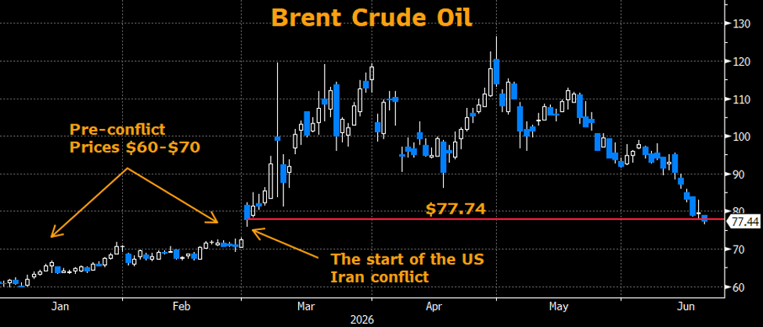
On the geopolitical front, peace talks, while still fragile, represent the most constructive progress since April. Oil markets responded decisively, with Brent crude breaking below $80 per barrel, its lowest level since the onset of hostilities. Despite this, volatility is likely to persist as supply chains normalize and inventories are rebuilt, even as lower prices could stimulate incremental demand.
The rates market, however, has remained stubbornly elevated. The 10-year Treasury yield dipped to ~4.42% before retracing modestly post-FOMC, while the more policy-sensitive 2-year yield reversed sharply - rising roughly 15 basis points after the hawkish messaging. By Thursday, yields settled into a range that suggests markets are tentatively accepting a more resolute anti-inflation stance from the new Fed regime.
Equities reflected this push-pull dynamic. Early-week optimism around peace talks drove a risk-on rally across major indices, but that momentum faded quickly. The Fed’s removal of easing bias and upward shift in rate expectations erased much of the advance, leaving markets caught between improving disinflation signals (via oil) and an increasingly hawkish policy backdrop.
Looking ahead, both near- and longer-term volatility is likely to increase. Reduced forward guidance from the Fed introduces greater uncertainty around the policy reaction function, widening the potential distribution of outcomes across asset markets. Meanwhile, a flatter yield curve - driven by rising front-end yields and more anchored long-end rates - underscores the market’s central dilemma: policy may remain tight enough to constrain growth, but not flexible enough to fully extinguish inflation risks.
From the Municipal Desk (with contributions from Ryan Riffe):
Municipals grinded stronger over the course of a shortened holiday week. With markets anxiously waiting for Wednesday's FOMC meeting, trading activity remained light for both Monday and Tuesday. A hawkish tone from Kevin Warsh’s first appearance sent treasury yields soaring along the 1 through 10-year part of the curve. In contrast, municipal bonds outperformed, with benchmark muni yields moving lower by as much as two basis points.
Since late May, sentiment within the municipal market has improved drastically. Attractive absolute yields, favorable ratios, steady reinvestment capital, and consistent inflows helped bolster the market. This positive backdrop has enabled municipals to largely shrug off the economic and geopolitical noise that continues to put pressure on other rate markets.
$11 Billion of new issue supply will look to be priced in next week, which is right on top of the year-to-date weekly average of $10.5 Billion.
Muni-Ratios Week Prior
2-YR Ratio @ 59% 2-YR Ratio @ 58%
3-YR Ratio @ 61% 3-YR Ratio @ 59%
5-YR Ratio @ 63% 5-YR Ratio @ 61%
10-YR Ratio @ 67% 10-YR Ratio @ 65%
30-YR Ratio @ 87% 30-YR Ratio @ 86%

An index is unmanaged and not available for direct investment. Definitions sourced from Bloomberg.
The Bloomberg Barclays Global Aggregate Negative Yielding Debt Market Value Index represents the portion of the Bloomberg Barclays Global Aggregate Index that measures the aggregate value of global debt with a negative yield. • The S&P 500® is widely regarded as the best single gauge of large-cap U.S. equities and serves as the foundation for a wide range of investment products. The index includes 500 leading companies and captures approximately 80% coverage of available market capitalization. • The NASDAQ Composite Index is a broad-based capitalization-weighted index of stocks in all three NASDAQ tiers: Global Select, Global Market and Capital Market. The index was developed with a base level of 100 as of February 5, 1971.• The Cboe Volatility Index® (VIX) is a calculation designed to produce a measure of constant, 30-day expected volatility of the US stock market, derived from real-time, mid-quote prices of weekly S&P 500® Index (SPX) call and put options with a range of 23 to 37 days to expiration.• The ICE BofA MOVE Index is a yield curve weighted index of the normalized implied volatility on 1-month Treasury options. It is the weighted average of implied volatilities on the CT2 (Current 2 Year Government Note), CT5 (Current 5 Year Government Note), CT10 (Current 10 Year Government Note), and CT30 (Current 30 Year Government Note), with weights 0.2/0.2/0.4/0.2 respectively.• The Markit CDX North America Investment Grade Index is composed of 125 equally weighted credit default swaps on investment grade entities, distributed among 6 sub-indices: High Volatility, Consumer, Energy, Financial, Industrial, and Technology, Media & Tele-communications. Markit CDX indices roll every 6 months in March & September. • The Markit CDX North America High Yield Index is composed of 100 non-investment grade entities, distributed among 2 sub-indices: B, BB. All entities are domiciled in North America. Markit CDX indices roll every 6 months in March & September. • The U.S. Dollar Index (USDX) indicates the general international value of the USD. The USDX does this by averaging the exchange rates between the USD and major world currencies. Intercontinental Exchange (ICE) US computes this by using the rates supplied by some 500 banks.
Investing involves certain risks, including possible loss of principal. You should understand and carefully consider a strategy’s objectives, risks, fees, expenses, and other information before investing. The views expressed in this commentary are subject to change and are not intended to be a recommendation or investment advice. Such views do not take into account the individual financial circumstances or objectives of any investor that receives them. All indices are unmanaged and are not available for direct investment. Indices do not incur costs including the payment of transaction costs, fees, and other expenses. This information should not be considered a solicitation or an offer to provide any service in any jurisdiction where it would be unlawful to do so under the laws of that jurisdiction. Past performance is no guarantee of future results.
© 2025 SWBC. All rights reserved. Securities offered through SWBC Investment Services, LLC, a registered broker/dealer. Member FINRA & SIPC. Advisory services offered through SWBC Investment Company, a Registered Investment Advisor, registered as such with the US Securities & Exchange Commission. SWBC Investment Services, LLC is under separate ownership from any other named entity. SWBC Investment Services, LLC a division of SWBC, is a nationwide partnership of advisor.
Let Us Know What You Thought about this Post.
Put your Comment Below.