
Housing market fundamentals remain challenging, with affordability continuing to be the industry's primary hurdle as home prices remain elevated relative to household incomes and price-to-income ratio...
The New Year’s holiday dampened activity, leaving markets sluggish on Friday after an early close midweek. Equities eased slightly as Treasury yields drifted higher but stayed within their recent three-month range.
Earlier in the week, FOMC minutes shed light on December’s 25 bp rate cut, revealing a divided Committee and the challenges behind the decision. While expectations point to no change in rates at the January meeting, some officials noted further cuts could be warranted in the future if inflation continues to ease. The impact of the government shutdown, which delayed key data releases, leaves markets waiting for clarity. Current odds of a January cut remain low at roughly 15%.
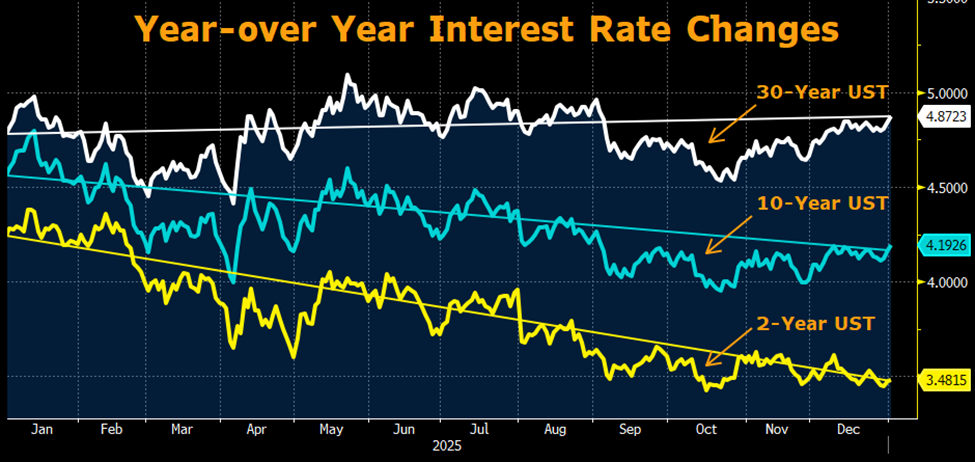
Rates remained well-contained at year's end. On a longer timeline, however, 10-year rates are down 40 bps on the year after closing near 4.17%, while 2-year yields have fallen nearly 75 bps to just below 3.50%, reflecting expectations for lower short-term rates. The long end tells a different story - 30-year yields ended 2025 slightly higher than a year ago, up 6 bps - underscoring how deficit and inflation concerns continue to temper the impact of Fed policy.
Equities failed to reach a new high during the final few trading sessions of the year, after peaking just below 6950 during the prior week. Looking ahead, the AI trade should continue to drive performance through early 2026 as ongoing AI-related capital expenditures should bolster the technology sector and drive improved corporate efficiencies across industries.
Equities closed the year shy of new highs after peaking near 6,950 during the prior week. Looking ahead, AI-driven capital spending is expected to remain a key performance driver in early 2026, particularly in the technology space, while boosting operational efficiency across sectors and improving margins accordingly.
From the Municipal Desk (with contributions from Ryan Riffe):
The holiday-shortened week kept muni trading quiet, although modest strength emerged in 3 to 7-year maturities, with yields down as much as 4 bps. The 10-year muni/UST ratio held near 67–68%, while front-end ratios stayed around 70%. Strong inflows into muni funds and ETFs should support demand, along with January reinvestment flows expected to exceed $50 billion for the month. With just $5.7 billion in new issuance expected next week, secondary markets will likely remain tight as accounts seek paper following a less active primary market during the prior two holiday weeks.
30-Day Visible Supply @ $8.24 Billion
Weekly Supply @ $5.7 Billion
2-YR Ratio @ 70%
3-YR Ratio @ 69%
5-YR Ratio @ 66%
10-YR Ratio @ 67%
30-YR Ratio @ 88%

An index is unmanaged and not available for direct investment. Definitions sourced from Bloomberg.
The Bloomberg Barclays Global Aggregate Negative Yielding Debt Market Value Index represents the portion of the Bloomberg Barclays Global Aggregate Index that measures the aggregate value of global debt with a negative yield. • The S&P 500® is widely regarded as the best single gauge of large-cap U.S. equities and serves as the foundation for a wide range of investment products. The index includes 500 leading companies and captures approximately 80% coverage of available market capitalization. • The NASDAQ Composite Index is a broad-based capitalization-weighted index of stocks in all three NASDAQ tiers: Global Select, Global Market and Capital Market. The index was developed with a base level of 100 as of February 5, 1971.• The Cboe Volatility Index® (VIX) is a calculation designed to produce a measure of constant, 30-day expected volatility of the US stock market, derived from real-time, mid-quote prices of weekly S&P 500® Index (SPX) call and put options with a range of 23 to 37 days to expiration.• The ICE BofA MOVE Index is a yield curve weighted index of the normalized implied volatility on 1-month Treasury options. It is the weighted average of implied volatilities on the CT2 (Current 2 Year Government Note), CT5 (Current 5 Year Government Note), CT10 (Current 10 Year Government Note), and CT30 (Current 30 Year Government Note), with weights 0.2/0.2/0.4/0.2 respectively.• The Markit CDX North America Investment Grade Index is composed of 125 equally weighted credit default swaps on investment grade entities, distributed among 6 sub-indices: High Volatility, Consumer, Energy, Financial, Industrial, and Technology, Media & Tele-communications. Markit CDX indices roll every 6 months in March & September. • The Markit CDX North America High Yield Index is composed of 100 non-investment grade entities, distributed among 2 sub-indices: B, BB. All entities are domiciled in North America. Markit CDX indices roll every 6 months in March & September. • The U.S. Dollar Index (USDX) indicates the general international value of the USD. The USDX does this by averaging the exchange rates between the USD and major world currencies. Intercontinental Exchange (ICE) US computes this by using the rates supplied by some 500 banks.
Investing involves certain risks, including possible loss of principal. You should understand and carefully consider a strategy’s objectives, risks, fees, expenses, and other information before investing. The views expressed in this commentary are subject to change and are not intended to be a recommendation or investment advice. Such views do not take into account the individual financial circumstances or objectives of any investor that receives them. All indices are unmanaged and are not available for direct investment. Indices do not incur costs including the payment of transaction costs, fees, and other expenses. This information should not be considered a solicitation or an offer to provide any service in any jurisdiction where it would be unlawful to do so under the laws of that jurisdiction. Past performance is no guarantee of future results.
© 2025 SWBC. All rights reserved. Securities offered through SWBC Investment Services, LLC, a registered broker/dealer. Member FINRA & SIPC. Advisory services offered through SWBC Investment Company, a Registered Investment Advisor, registered as such with the US Securities & Exchange Commission. SWBC Investment Services, LLC is under separate ownership from any other named entity. SWBC Investment Services, LLC a division of SWBC, is a nationwide partnership of advisor.
Let Us Know What You Thought about this Post.
Put your Comment Below.