
Housing market fundamentals remain challenging, with affordability continuing to be the industry's primary hurdle as home prices remain elevated relative to household incomes and price-to-income ratio...
The SCOTUS Ruling, Geopolitics, Tariffs, and Sticky Inflation Keep Markets on Edge
The Supreme Court ruling against the IEPPA tariffs injected immediate uncertainty into markets, reminding investors that the bond market typically discounts the unknown before it evaluates fundamentals. While equities ultimately steadied, Treasuries retained a softer tone, pushing 10-year yields off the 4% threshold tested earlier in the week. As is often the case with potentially far-reaching policy shifts, the ruling raises more questions than it answers. One early interpretation is that the decision could prove disinflationary if investors view the previously implemented tariffs as carrying a reflationary bias.
In the hours that followed, President Trump quickly signaled that the administration would pivot to a plan B, including a universal 10% levy using Section 301 of the Trade Act of 1974 as a statutory footing. Despite the legal setback, markets did not treat the ruling as a definitive end to the administration’s pro-growth tariff ambitions. Instead, pricing reflected the view that multiple pathways remain for advancing the policy framework, keeping tariff risk - and its macro implications - very much alive.
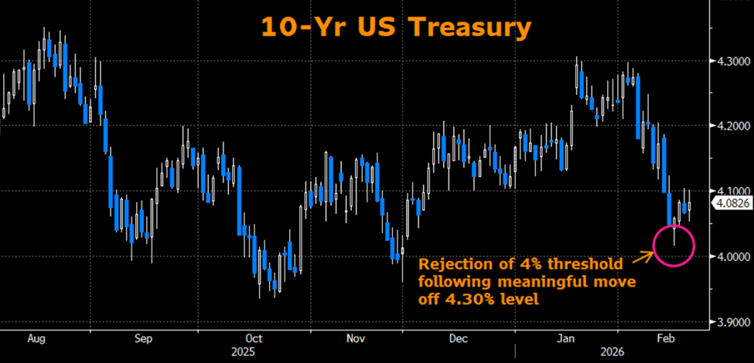
Economic data last week reinforced the theme of sticky inflation. Core PCE printed an unrounded 0.355% month‑over‑month (rounded to 0.4%), marking the largest monthly increase in a year. Unsurprisingly, Treasuries rejected the 4.015% yield lows in response, with rates drifting higher as investors recalibrated inflation persistence and the probability of near-term Fed cuts.
Growth data were similarly discouraging. Initial Q4 real GDP estimates landed at +1.4%, well below the expected 2.8%. The Bureau of Economic Analysis noted that the 43-day government shutdown shaved roughly 1 percentage point off quarterly growth - consistent with my earlier statements that each week of shutdown weighs on GDP by 0.1% to 0.2%. The print reinforces concerns that the economy ended the year with less underlying momentum than previously assumed.
Compounding the macro backdrop, rising geopolitical tensions with Iran introduce yet another layer of uncertainty. The risk of higher oil prices and the accompanying inflationary impulses sits alongside the potential for a flight‑to‑quality bid in Treasuries. Markets will now need to navigate the crosscurrents of policy ambiguity, uneven data, and geopolitical risk as they assess the path ahead.
From the Municipal Desk (with contributions from Ryan Riffe):
Municipal activity remained relatively consistent from the prior week, albeit with a slightly more muted tone as the week progressed. Inflows continue to be solid, as supply slowed modestly. MMD benchmark yields were bumped earlier in the week as slightly more attractive ratios versus the historically tight environment in which we find the market may have spurred some interest. The headline Chicago O’Hare deal on Wednesday was met with strong demand as investors reached for a spread in the tighter municipal market. Demand for the loan pushed yields lower by as much as 13 basis points as the deal was upsized from $475 million to $610 million. As we move forward into the historically challenging March to April time period for tax-exempt paper, accounts are well aware of the potential challenges and technical pressures for the market.
Municipal activity remained largely in line with the prior week, though the tone softened modestly as the week progressed. Fund inflows remained healthy while new‑issue supply eased slightly. MMD benchmark yields were marked lower early in the week, as marginally more appealing ratios relative to the historically tight range encouraged incremental buyer interest. The week’s marquee transaction - the Chicago O’Hare offering - saw robust demand, with investors reaching down the credit spectrum for spread in a constrained municipal market. Strong subscription levels pushed yields lower by as much as 13 basis points and increased the deal size from $475 million to $610 million.
As we approach the traditionally challenging March‑to‑April period for tax-exempt paper, accounts are increasingly mindful of the potential technical headwinds and liquidity pressures that could influence market behavior.
US TSY 2yr 3.487% 59%
US TSY 3yr 3.508% 59%
US TSY 5yr 3.655% 58%
US TSY 10yr 4.090% 62%
US TSY 30yr 4.727% 89%
 An index is unmanaged and not available for direct investment. Definitions sourced from Bloomberg.
The Bloomberg Barclays Global Aggregate Negative Yielding Debt Market Value Index represents the portion of the Bloomberg Barclays Global Aggregate Index that measures the aggregate value of global debt with a negative yield. • The S&P 500® is widely regarded as the best single gauge of large-cap U.S. equities and serves as the foundation for a wide range of investment products. The index includes 500 leading companies and captures approximately 80% coverage of available market capitalization. • The NASDAQ Composite Index is a broad-based capitalization-weighted index of stocks in all three NASDAQ tiers: Global Select, Global Market and Capital Market. The index was developed with a base level of 100 as of February 5, 1971.• The Cboe Volatility Index® (VIX) is a calculation designed to produce a measure of constant, 30-day expected volatility of the US stock market, derived from real-time, mid-quote prices of weekly S&P 500® Index (SPX) call and put options with a range of 23 to 37 days to expiration.• The ICE BofA MOVE Index is a yield curve weighted index of the normalized implied volatility on 1-month Treasury options. It is the weighted average of implied volatilities on the CT2 (Current 2 Year Government Note), CT5 (Current 5 Year Government Note), CT10 (Current 10 Year Government Note), and CT30 (Current 30 Year Government Note), with weights 0.2/0.2/0.4/0.2 respectively.• The Markit CDX North America Investment Grade Index is composed of 125 equally weighted credit default swaps on investment grade entities, distributed among 6 sub-indices: High Volatility, Consumer, Energy, Financial, Industrial, and Technology, Media & Tele-communications. Markit CDX indices roll every 6 months in March & September. • The Markit CDX North America High Yield Index is composed of 100 non-investment grade entities, distributed among 2 sub-indices: B, BB. All entities are domiciled in North America. Markit CDX indices roll every 6 months in March & September. • The U.S. Dollar Index (USDX) indicates the general international value of the USD. The USDX does this by averaging the exchange rates between the USD and major world currencies. Intercontinental Exchange (ICE) US computes this by using the rates supplied by some 500 banks.
Investing involves certain risks, including possible loss of principal. You should understand and carefully consider a strategy’s objectives, risks, fees, expenses, and other information before investing. The views expressed in this commentary are subject to change and are not intended to be a recommendation or investment advice. Such views do not take into account the individual financial circumstances or objectives of any investor that receives them. All indices are unmanaged and are not available for direct investment. Indices do not incur costs including the payment of transaction costs, fees, and other expenses. This information should not be considered a solicitation or an offer to provide any service in any jurisdiction where it would be unlawful to do so under the laws of that jurisdiction. Past performance is no guarantee of future results.
© 2025 SWBC. All rights reserved. Securities offered through SWBC Investment Services, LLC, a registered broker/dealer. Member FINRA & SIPC. Advisory services offered through SWBC Investment Company, a Registered Investment Advisor, registered as such with the US Securities & Exchange Commission. SWBC Investment Services, LLC is under separate ownership from any other named entity. SWBC Investment Services, LLC a division of SWBC, is a nationwide partnership of advisor.

Let Us Know What You Thought about this Post.
Put your Comment Below.