
Housing, Inflation, and Geopolitics: A Week That Reframed Market Expectations I had the distinct pleasure of speaking at the 2026 Texas Mortgage Bankers Association Conference in Houston last week. Un...
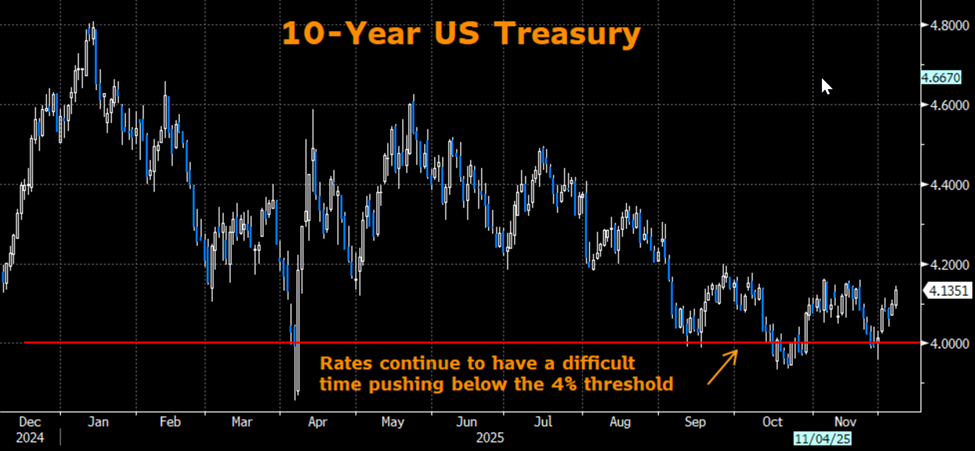
News out of Washington suggests that President Trump has already settled on his choice to replace Powell as Chair of the FOMC, fueling speculation that Kevin Hassett is the leading candidate. Despite Hassett’s well-known dovish leanings, the bond market appears reluctant to chase lower yields, as rates held above the 4% threshold and generally trended higher throughout the week. This hesitation likely reflects the Committee’s current divide. Some members are signaling an imminent rate cut while others favor holding the Fed Funds rate steady at Wednesday’s meeting, keeping downward pressure on longer-end yields muted.
Friday’s economic data release, though based on September figures, was welcomed by traders but did little to shift the prevailing narrative - markets continue to price in a 25 basis point cut with over 95% certainty. Core PCE met expectations at 0.2% MoM and ticked up slightly to 2.8% YoY. Meanwhile, the University of Michigan Consumer Sentiment Index edged higher and beat forecasts, yet remains deeply depressed. The disconnect persists between consumer surveys reflecting heightened anxiety over economic conditions and personal finances, while spending data shows no meaningful slowdown in consumption.
Labor market indicators, including ADP and weekly jobless claims, reinforce the “cooling” story, providing ample support for the dovish camp. The emerging theme of ‘no-firing but no-hiring’ is not overtly negative, but it does little to inspire confidence in labor market health.
Alongside the rate decision, attention will turn to the updated SEP (dot plot), offering insight into FOMC expectations for 2026. Notably, just one dot falling below the current median forecast of 3.375% would signal that officials anticipate 50 basis points of cuts next year.
From the Municipal Desk (with contributions from Ryan Riffe):
As the market inches closer to year-end, municipals had another positive week as an above-average calendar of $16 billion was successfully absorbed. Combined with steady capital inflows into municipal funds and ETFs, December's increased reinvestment capital helped the market perform solidly. Secondary trading volume slowed midweek as investors focused primarily on the new issue front. Negotiated deals were generally well received with minimal syndicate balances, while competitive bids remained strong. The MMD scale finished the week steeper with yields rising as much as 5 basis points, most notably in the 10-30 yr maturity range. The front end of the curve experienced modest strength, likely from several contributing factors:
- The SIFMA variable rate index dropped to 1.92% - making fixed rate securities more attractive.
- Investors are beginning to reduce duration risk as the market approaches year-end.
- Attractive ratios (close to 70% inside 10-Years) is maintaining stronger investor demand
With just two full trading weeks left in 2025, the market looks to price in $11 billion of new issue supply. We anticipate the primary market to continue its ability to draw strong investor focus, as supply will wane as the holiday period nears. The 2025 municipal supply picture is expected to come in slightly above the top-end of our forecasted range, expressed at the beginning of the year, between $525 to $550 billion. Last week, we published our forecast for 2026, with a slight increase over 2025’s record level, with an increase to between $580 to $600 billion as a base-case scenario. We assign a small chance for a “champagne-popping worthy” rise above the $600 billion threshold as the expanding need for infrastructure build should continue into next year.
30-Day Visible Supply @ $14.4 Billion
Weekly Calendar expected @ $11 Billion
2-YR Ratio @ 68%
3-YR Ratio @ 68%
5-YR Ratio @ 65%
10-YR Ratio @ 67%
30-YR Ratio @ 88%

An index is unmanaged and not available for direct investment. Definitions sourced from Bloomberg.
The Bloomberg Barclays Global Aggregate Negative Yielding Debt Market Value Index represents the portion of the Bloomberg Barclays Global Aggregate Index that measures the aggregate value of global debt with a negative yield. • The S&P 500® is widely regarded as the best single gauge of large-cap U.S. equities and serves as the foundation for a wide range of investment products. The index includes 500 leading companies and captures approximately 80% coverage of available market capitalization. • The NASDAQ Composite Index is a broad-based capitalization-weighted index of stocks in all three NASDAQ tiers: Global Select, Global Market and Capital Market. The index was developed with a base level of 100 as of February 5, 1971.• The Cboe Volatility Index® (VIX) is a calculation designed to produce a measure of constant, 30-day expected volatility of the US stock market, derived from real-time, mid-quote prices of weekly S&P 500® Index (SPX) call and put options with a range of 23 to 37 days to expiration.• The ICE BofA MOVE Index is a yield curve weighted index of the normalized implied volatility on 1-month Treasury options. It is the weighted average of implied volatilities on the CT2 (Current 2 Year Government Note), CT5 (Current 5 Year Government Note), CT10 (Current 10 Year Government Note), and CT30 (Current 30 Year Government Note), with weights 0.2/0.2/0.4/0.2 respectively.• The Markit CDX North America Investment Grade Index is composed of 125 equally weighted credit default swaps on investment grade entities, distributed among 6 sub-indices: High Volatility, Consumer, Energy, Financial, Industrial, and Technology, Media & Tele-communications. Markit CDX indices roll every 6 months in March & September. • The Markit CDX North America High Yield Index is composed of 100 non-investment grade entities, distributed among 2 sub-indices: B, BB. All entities are domiciled in North America. Markit CDX indices roll every 6 months in March & September. • The U.S. Dollar Index (USDX) indicates the general international value of the USD. The USDX does this by averaging the exchange rates between the USD and major world currencies. Intercontinental Exchange (ICE) US computes this by using the rates supplied by some 500 banks.
Investing involves certain risks, including possible loss of principal. You should understand and carefully consider a strategy’s objectives, risks, fees, expenses, and other information before investing. The views expressed in this commentary are subject to change and are not intended to be a recommendation or investment advice. Such views do not take into account the individual financial circumstances or objectives of any investor that receives them. All indices are unmanaged and are not available for direct investment. Indices do not incur costs including the payment of transaction costs, fees, and other expenses. This information should not be considered a solicitation or an offer to provide any service in any jurisdiction where it would be unlawful to do so under the laws of that jurisdiction. Past performance is no guarantee of future results.
© 2025 SWBC. All rights reserved. Securities offered through SWBC Investment Services, LLC, a registered broker/dealer. Member FINRA & SIPC. Advisory services offered through SWBC Investment Company, a Registered Investment Advisor, registered as such with the US Securities & Exchange Commission. SWBC Investment Services, LLC is under separate ownership from any other named entity. SWBC Investment Services, LLC a division of SWBC, is a nationwide partnership of advisor.

Let Us Know What You Thought about this Post.
Put your Comment Below.