
Housing market fundamentals remain challenging, with affordability continuing to be the industry's primary hurdle as home prices remain elevated relative to household incomes and price-to-income ratio...
“Fed Delivers Hawkish Cut Amid Liquidity Boost - Markets Eye Jobs Data Next.”
The much-anticipated 25 bp Fed Funds rate cut arrived on Wednesday, followed by a press conference where Chair Powell struck a more hawkish tone than the dovish rate cut would imply. The official statement reiterated language signaling a pause in the cutting cycle, while Powell warned there is “no risk-free path” as the Fed navigates its dual mandate. He emphasized that recent normalization should stabilize the labor market while inflation trends lower once tariff effects fade.
The FOMC remains divided, as reflected in the 9–3 vote and the latest dot plot, which held its median 2026 projection steady - implying only one additional cut next year. Markets, on the other hand, are slightly more aggressive, anticipating two cuts, though I expect the Fed’s forecast to shift lower by mid-2026. This is not a call to ‘fight the Fed,’ but rather a recognition that long-term rate projections are notoriously unreliable - and right now, I believe markets have the edge over the Fed’s forecasts.
A less headline-grabbing but still significant move was the Fed’s announcement of Reserve Management Purchases (RMP) - about $40 billion per month in short-term T-bill purchases to maintain ample reserves and prevent funding market volatility. Unlike QE, which grows the Fed’s balance sheet via the purchase of long-term Treasuries, thereby suppressing yields further out the curve, RMP is a technical liquidity measure. Notably, these purchases will absorb nearly all expected T-bill issuance, raising questions about whether the Treasury will decrease supply at the long end in response to the Fed’s purchasing efforts.
Looking ahead, Tuesday brings the combined October–November employment report, with consensus at +50k NFP and unemployment at 4.5%. Following weak private payroll signals from ADP and Revelio Labs, continued cooling of the labor market is widely anticipated. Will there be any surprises in the data to shock the markets out of the comfortable range in which they have settled of late?
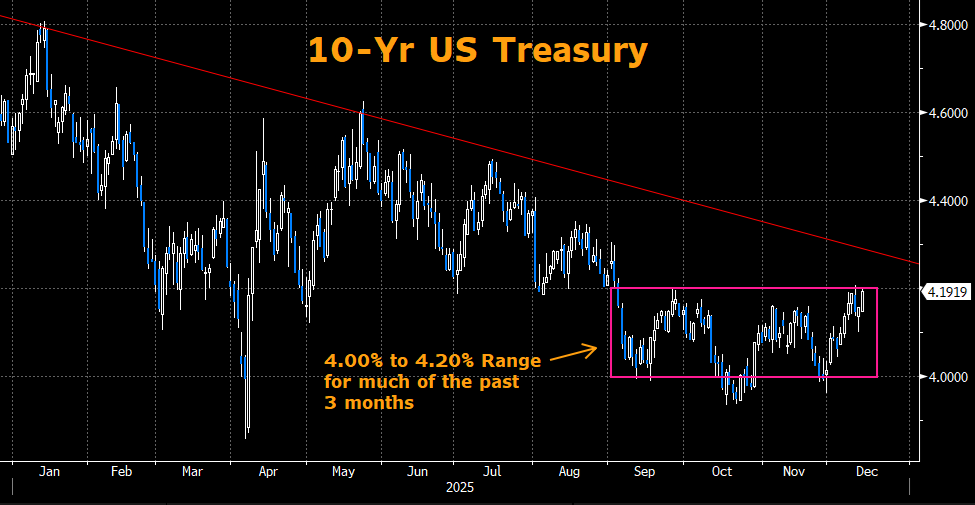
Markets remain range-bound: the S&P has remained just below October’s all-time high of 6,920, leaving my 7,000-year-end target within reach but elusive. There remain a few more shopping days until Christmas; thus, the Santa Rally, which has yet to arrive, may still materialize. Rates are anchored, with 10-year yields between 4.00% and 4.20%, while the 2-year Note stays above 3.50%, echoing expectations for limited near-term easing.
From the Municipal Desk (with contributions from Ryan Riffe):
Last week was a quiet yet steady period for the municipal market. While municipals underperformed relative to Treasuries, the MMD scale remained largely unchanged throughout the week. The market absorbed what is expected to be the last meaningful wave of new-issue supply, totaling $14.2 billion. With attention firmly dedicated to the primary market, syndicate balances were generally light as many deals were subscribed anywhere from 1 to 3+ times across the curve. Although municipal fund inflows decreased, they remained positive, completing three consecutive weeks of positive flows. Next week marks the last full trading week of 2025, with new-issue supply expected to price around $6 billion. We anticipate the municipal market will continue to trade sideways through year-end, as participants position for a quiet close to the calendar year.
30-Day Visible Supply @ $8.285 Billion
Weekly Calendar expected @ $6 Billion
2-YR Ratio @ 69%
3-YR Ratio @ 68%
5-YR Ratio @ 65%
10-YR Ratio @ 67%
30-YR Ratio @ 88%

An index is unmanaged and not available for direct investment. Definitions sourced from Bloomberg.
The Bloomberg Barclays Global Aggregate Negative Yielding Debt Market Value Index represents the portion of the Bloomberg Barclays Global Aggregate Index that measures the aggregate value of global debt with a negative yield. • The S&P 500® is widely regarded as the best single gauge of large-cap U.S. equities and serves as the foundation for a wide range of investment products. The index includes 500 leading companies and captures approximately 80% coverage of available market capitalization. • The NASDAQ Composite Index is a broad-based capitalization-weighted index of stocks in all three NASDAQ tiers: Global Select, Global Market and Capital Market. The index was developed with a base level of 100 as of February 5, 1971.• The Cboe Volatility Index® (VIX) is a calculation designed to produce a measure of constant, 30-day expected volatility of the US stock market, derived from real-time, mid-quote prices of weekly S&P 500® Index (SPX) call and put options with a range of 23 to 37 days to expiration.• The ICE BofA MOVE Index is a yield curve weighted index of the normalized implied volatility on 1-month Treasury options. It is the weighted average of implied volatilities on the CT2 (Current 2 Year Government Note), CT5 (Current 5 Year Government Note), CT10 (Current 10 Year Government Note), and CT30 (Current 30 Year Government Note), with weights 0.2/0.2/0.4/0.2 respectively.• The Markit CDX North America Investment Grade Index is composed of 125 equally weighted credit default swaps on investment grade entities, distributed among 6 sub-indices: High Volatility, Consumer, Energy, Financial, Industrial, and Technology, Media & Tele-communications. Markit CDX indices roll every 6 months in March & September. • The Markit CDX North America High Yield Index is composed of 100 non-investment grade entities, distributed among 2 sub-indices: B, BB. All entities are domiciled in North America. Markit CDX indices roll every 6 months in March & September. • The U.S. Dollar Index (USDX) indicates the general international value of the USD. The USDX does this by averaging the exchange rates between the USD and major world currencies. Intercontinental Exchange (ICE) US computes this by using the rates supplied by some 500 banks.
Investing involves certain risks, including possible loss of principal. You should understand and carefully consider a strategy’s objectives, risks, fees, expenses, and other information before investing. The views expressed in this commentary are subject to change and are not intended to be a recommendation or investment advice. Such views do not take into account the individual financial circumstances or objectives of any investor that receives them. All indices are unmanaged and are not available for direct investment. Indices do not incur costs including the payment of transaction costs, fees, and other expenses. This information should not be considered a solicitation or an offer to provide any service in any jurisdiction where it would be unlawful to do so under the laws of that jurisdiction. Past performance is no guarantee of future results.
© 2025 SWBC. All rights reserved. Securities offered through SWBC Investment Services, LLC, a registered broker/dealer. Member FINRA & SIPC. Advisory services offered through SWBC Investment Company, a Registered Investment Advisor, registered as such with the US Securities & Exchange Commission. SWBC Investment Services, LLC is under separate ownership from any other named entity. SWBC Investment Services, LLC a division of SWBC, is a nationwide partnership of advisor.

Let Us Know What You Thought about this Post.
Put your Comment Below.