
Housing market fundamentals remain challenging, with affordability continuing to be the industry's primary hurdle as home prices remain elevated relative to household incomes and price-to-income ratio...
Markets Pause, Fed Uncertainty Remains
The Strait of Hormuz saga added yet another chapter this week. Reports suggesting a breakthrough and imminent reopening once again unraveled, extending a familiar pattern of optimism followed by disappointment. Brent crude oil prices reacted accordingly, although market participants appear increasingly fatigued by the recurring cycle of headline-driven volatility.
Attention ultimately shifted back to economic fundamentals. Following the prior week's softer employment report, both CPI and PPI data surprised to the downside, indicating a more favorable inflation environment than consensus expectations. The inflation data prompted a significant repricing of Federal Reserve expectations. Fed Funds futures reduced the implied probability of a September rate hike from 48% to 31%.
While the market's conviction regarding an immediate move diminished, investors continue to assign meaningful odds to at least one additional rate hike before year-end.
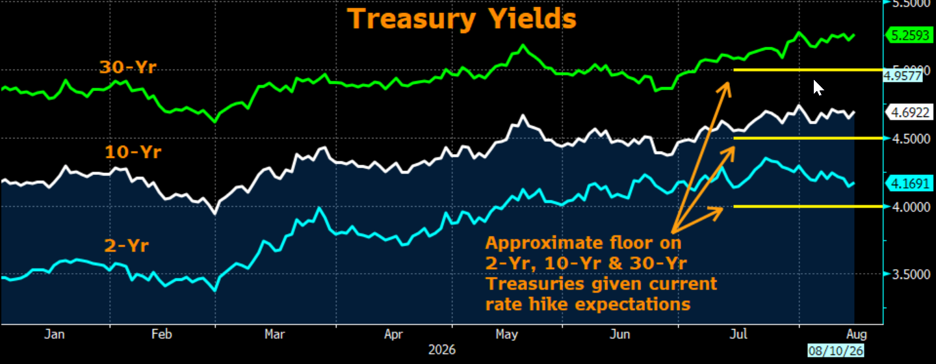
Treasury yields responded positively to the improved inflation backdrop. The recent upward march in rates paused, with the 10-year Treasury yield peaking at 4.72% and the 30-year Treasury bond holding relatively stable after touching 5.25%. With signs of disinflation emerging and no additional August inflation data scheduled for release until September 10 and 11, the market appears poised to enter a period of consolidation. In the near term, the path of least resistance for long-dated yields is likely lower.
The front end of the yield curve remains the most compelling area to watch as markets continue to recalibrate expectations for Federal Reserve policy. If the Fed ultimately raises the target Fed Funds rate beyond its current 3.50% to 3.75% range, as futures markets continue to imply, shorter-maturity Treasury yields are unlikely to decline substantially from current levels.
Put simply, the policy rate should continue to provide an effective floor beneath Treasury yields.
As a result, we continue to view around 4.00% as a floor for 2-year Treasuries, 4.50% for 10-year Treasuries, and roughly 5.00% for 30-year bonds. While inflation trends have improved and long-end yields may drift lower in the near term, the market's expectation for at least one additional Fed move this year should limit the scope for a meaningful decline in rates across the curve.
From the Municipal Desk
Contributions from Ryan Riffe
Summer doldrums have settled into the municipal market, producing a modest decline in activity without materially affecting liquidity or pricing. While Treasury yields experienced meaningful volatility last week, municipals largely shrugged off the move and traded with comparatively little rate sensitivity.
This week's calendar is expected to surpass $15 billion, and the market's ability to digest that supply will be closely watched. Given the robust issuance environment, some modest spread concession may be necessary to clear deals efficiently. Fortunately, ongoing reinvestment flows from coupon payments, maturities, and calls continue to provide a strong technical backdrop that should help absorb the increased supply.

An index is unmanaged and not available for direct investment. Definitions sourced from Bloomberg.
The Bloomberg Barclays Global Aggregate Negative Yielding Debt Market Value Index represents the portion of the Bloomberg Barclays Global Aggregate Index that measures the aggregate value of global debt with a negative yield. • The S&P 500® is widely regarded as the best single gauge of large-cap U.S. equities and serves as the foundation for a wide range of investment products. The index includes 500 leading companies and captures approximately 80% coverage of available market capitalization. • The NASDAQ Composite Index is a broad-based capitalization-weighted index of stocks in all three NASDAQ tiers: Global Select, Global Market and Capital Market. The index was developed with a base level of 100 as of February 5, 1971.• The Cboe Volatility Index® (VIX) is a calculation designed to produce a measure of constant, 30-day expected volatility of the US stock market, derived from real-time, mid-quote prices of weekly S&P 500® Index (SPX) call and put options with a range of 23 to 37 days to expiration.• The ICE BofA MOVE Index is a yield curve weighted index of the normalized implied volatility on 1-month Treasury options. It is the weighted average of implied volatilities on the CT2 (Current 2 Year Government Note), CT5 (Current 5 Year Government Note), CT10 (Current 10 Year Government Note), and CT30 (Current 30 Year Government Note), with weights 0.2/0.2/0.4/0.2 respectively.• The Markit CDX North America Investment Grade Index is composed of 125 equally weighted credit default swaps on investment grade entities, distributed among 6 sub-indices: High Volatility, Consumer, Energy, Financial, Industrial, and Technology, Media & Tele-communications. Markit CDX indices roll every 6 months in March & September. • The Markit CDX North America High Yield Index is composed of 100 non-investment grade entities, distributed among 2 sub-indices: B, BB. All entities are domiciled in North America. Markit CDX indices roll every 6 months in March & September. • The U.S. Dollar Index (USDX) indicates the general international value of the USD. The USDX does this by averaging the exchange rates between the USD and major world currencies. Intercontinental Exchange (ICE) US computes this by using the rates supplied by some 500 banks.
Investing involves certain risks, including possible loss of principal. You should understand and carefully consider a strategy’s objectives, risks, fees, expenses, and other information before investing. The views expressed in this commentary are subject to change and are not intended to be a recommendation or investment advice. Such views do not take into account the individual financial circumstances or objectives of any investor that receives them. All indices are unmanaged and are not available for direct investment. Indices do not incur costs including the payment of transaction costs, fees, and other expenses. This information should not be considered a solicitation or an offer to provide any service in any jurisdiction where it would be unlawful to do so under the laws of that jurisdiction. Past performance is no guarantee of future results.
© 2025 SWBC. All rights reserved. Securities offered through SWBC Investment Services, LLC, a registered broker/dealer. Member FINRA & SIPC. Advisory services offered through SWBC Investment Company, a Registered Investment Advisor, registered as such with the US Securities & Exchange Commission. SWBC Investment Services, LLC is under separate ownership from any other named entity. SWBC Investment Services, LLC a division of SWBC, is a nationwide partnership of advisor.

Let Us Know What You Thought about this Post.
Put your Comment Below.