
Housing market fundamentals remain challenging, with affordability continuing to be the industry's primary hurdle as home prices remain elevated relative to household incomes and price-to-income ratio...
Oil Shock from Iran Conflict Drives Markets Lower as Yields Surge
The conflict with Iran remains the dominant force shaping global financial market behavior, primarily through its impact on surging oil prices. With Brent crude climbing above $100 per barrel, equity markets have consistently come under pressure while Treasury yields continue to creep higher. Concerns over the potential drag on global economic growth are weighing heavily on stocks, even as rising inflation expectations push interest rates upward.
Iran’s continued threats, its refusal to signal de‑escalation, and ongoing attacks on cargo vessels in the Strait of Hormuz have only intensified market anxiety. Despite occasional statements from President Trump suggesting that Iran was “about to surrender,” there is little evidence that hostilities are nearing an end.
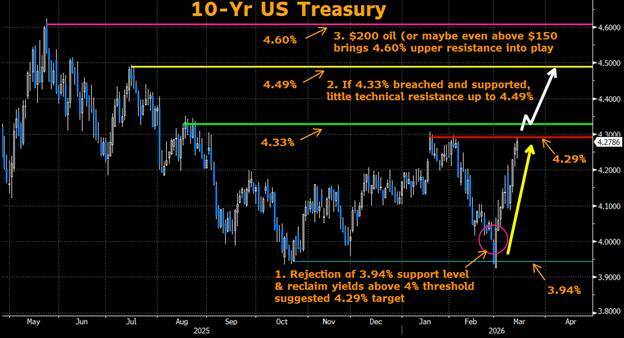
Once the 10‑year Treasury yield moved decisively above the 4% mark - coupled with inflation risks stemming from elevated oil prices - we set our sights on the January peak closing level of 4.29%, with an interim technical checkpoint at 4.21%. By Friday afternoon, the 10‑year had nearly reached that upper bound. Treasury futures have clearly outlined the key support and resistance zones throughout this period, presenting compelling short‑position opportunities as yields pushed higher over the past two weeks, of which we have taken advantage in our positioning.
Looking forward, interest rates are likely to track the volatility of oil. Technical levels suggest notable resistance slightly above the current range, and from a purely technical perspective, once the 4.33% level is breached and supported, there is limited impediment to a further move toward 4.49% - particularly if crude prices resume climbing and break above the previous ~$120 per‑barrel peak. Should this breakout occur, I plan to increase short exposure to capitalize on the next leg higher.
On Friday morning, core PCE for January arrived largely in line with expectations, registering a year‑over‑year increase of 3.1%. Importantly, this data does not yet reflect the price impacts stemming from the Iran conflict, which implies upward pressure in upcoming first‑quarter readings. Meanwhile, the second estimate of fourth‑quarter GDP was revised down from 1.4% to 0.7%, offering momentary hope to dovish investors that the Federal Reserve might adopt a more accommodative stance. However, by the market close, renewed inflation concerns - driven by higher oil - had reasserted themselves, pushing yields up and leaving equity markets firmly in negative territory.
From the Municipal Desk:
Municipal yields generally tracked the direction of Treasuries but ultimately underperformed, rising at a faster pace than comparable government rates over the past week. This outcome was largely anticipated, given that municipals had shown modest outperformance the prior week as the initial move toward higher rates began to take shape. Despite the weaker price action, dealer bid‑side levels held up reasonably well, providing stability through the volatility.
Investors welcomed the opportunity to buy at the most attractive absolute yield levels seen since January, taking advantage of pockets of value across the curve. Meanwhile, this week’s lighter supply - declining to roughly $9 billion from last week’s $13.3 billion - may create enough of a supply/demand imbalance to keep buyers engaged and maintain competitive dealer bid‑side support.
As we approach the April 15 tax deadline, the municipal market typically experiences a seasonal slowdown, as investors redirect liquidity toward tax payments and defer reinvestment decisions. During this period, municipal‑to‑Treasury ratios are likely to improve, offering more compelling relative value as the market adjusts to shifting demand dynamics.
US TSY 2yr 3.751% 58%
US TSY 3yr 3.764% 60%
US TSY 5yr 3.870% 61%
US TSY 10yr 4.257% 67%
US TSY 30yr 4.870% 89%

An index is unmanaged and not available for direct investment. Definitions sourced from Bloomberg.
The Bloomberg Barclays Global Aggregate Negative Yielding Debt Market Value Index represents the portion of the Bloomberg Barclays Global Aggregate Index that measures the aggregate value of global debt with a negative yield. • The S&P 500® is widely regarded as the best single gauge of large-cap U.S. equities and serves as the foundation for a wide range of investment products. The index includes 500 leading companies and captures approximately 80% coverage of available market capitalization. • The NASDAQ Composite Index is a broad-based capitalization-weighted index of stocks in all three NASDAQ tiers: Global Select, Global Market and Capital Market. The index was developed with a base level of 100 as of February 5, 1971.• The Cboe Volatility Index® (VIX) is a calculation designed to produce a measure of constant, 30-day expected volatility of the US stock market, derived from real-time, mid-quote prices of weekly S&P 500® Index (SPX) call and put options with a range of 23 to 37 days to expiration.• The ICE BofA MOVE Index is a yield curve weighted index of the normalized implied volatility on 1-month Treasury options. It is the weighted average of implied volatilities on the CT2 (Current 2 Year Government Note), CT5 (Current 5 Year Government Note), CT10 (Current 10 Year Government Note), and CT30 (Current 30 Year Government Note), with weights 0.2/0.2/0.4/0.2 respectively.• The Markit CDX North America Investment Grade Index is composed of 125 equally weighted credit default swaps on investment grade entities, distributed among 6 sub-indices: High Volatility, Consumer, Energy, Financial, Industrial, and Technology, Media & Tele-communications. Markit CDX indices roll every 6 months in March & September. • The Markit CDX North America High Yield Index is composed of 100 non-investment grade entities, distributed among 2 sub-indices: B, BB. All entities are domiciled in North America. Markit CDX indices roll every 6 months in March & September. • The U.S. Dollar Index (USDX) indicates the general international value of the USD. The USDX does this by averaging the exchange rates between the USD and major world currencies. Intercontinental Exchange (ICE) US computes this by using the rates supplied by some 500 banks.
Investing involves certain risks, including possible loss of principal. You should understand and carefully consider a strategy’s objectives, risks, fees, expenses, and other information before investing. The views expressed in this commentary are subject to change and are not intended to be a recommendation or investment advice. Such views do not take into account the individual financial circumstances or objectives of any investor that receives them. All indices are unmanaged and are not available for direct investment. Indices do not incur costs including the payment of transaction costs, fees, and other expenses. This information should not be considered a solicitation or an offer to provide any service in any jurisdiction where it would be unlawful to do so under the laws of that jurisdiction. Past performance is no guarantee of future results.
© 2025 SWBC. All rights reserved. Securities offered through SWBC Investment Services, LLC, a registered broker/dealer. Member FINRA & SIPC. Advisory services offered through SWBC Investment Company, a Registered Investment Advisor, registered as such with the US Securities & Exchange Commission. SWBC Investment Services, LLC is under separate ownership from any other named entity. SWBC Investment Services, LLC a division of SWBC, is a nationwide partnership of advisor.

Let Us Know What You Thought about this Post.
Put your Comment Below.