
Housing market fundamentals remain challenging, with affordability continuing to be the industry's primary hurdle as home prices remain elevated relative to household incomes and price-to-income ratio...
Last week, investors remained focused on the repercussions of the DOJ’s subpoena of Chair Powell, particularly his firm and pointed response. Markets largely drifted within their recent trading ranges as concerns resurfaced over potential challenges to the Federal Reserve’s independence.
The Supreme Court delivered yet another head‑fake on the long-awaited ruling over President Trump’s tariff authority, failing to issue a decision on the high-profile tariff case despite heightened expectations. With justices meeting only in private conferences and offering no advance notice of which opinions will be released, markets and policymakers are left to navigate continued uncertainty as the Court signals that a decision may still be days or even weeks away.
On Friday, President Trump’s remarks suggesting he may prefer to keep Kevin Hassett in his role as director of the National Economic Council increased market expectations that Kevin Warsh is now the leading candidate for the nomination, pushing implied odds above 60%. Interest rates responded with a steady sell-off throughout the session, with 10-year Treasury yields closing above 4.20%, a level that has repeatedly served as upside resistance.
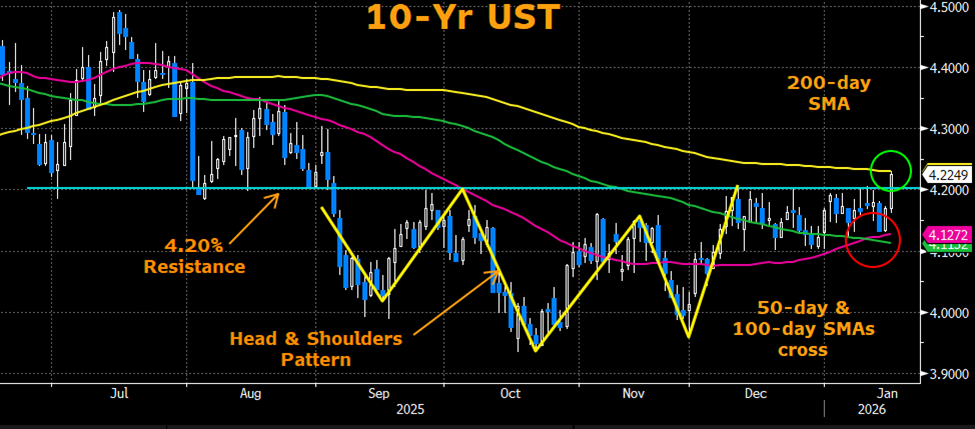
Market technicians are highlighting several technical developments that could support a continued move higher in rates. The 10‑Year Treasury’s daily and weekly closes above the long‑standing 4.20% resistance level (blue line) stand out as a meaningful breakout. Momentum signals have also strengthened - the 50‑day and 100‑day simple moving averages have crossed (red circle), and yields tested the 200‑day moving average (green circle). In addition, an inverse head‑and‑shoulders formation (yellow zig‑zag) offers another constructive signal that rates may have further room to rise. If this breakout holds, the next logical upside target sits near 4.35%.
Equities traded in a relatively subdued fashion throughout the week and were unable to push meaningfully higher, as headlines surrounding the Fed Chair weighed on broader sentiment and capped gains in the S&P 500. Meanwhile, small-cap stocks continued to outperform, reflecting the sector’s ongoing resilience and the sustained strength of the AI-driven trade that has powered much of the market’s leadership over the past year.
Looking ahead, the MLK holiday-shortened week, coupled with a relatively light economic calendar, should keep markets quieter absent unexpected geopolitical events. The Fed is in a quiet period ahead of the next FOMC meeting, but we will receive the latest core-PCE data, though its relevance is likely compromised given the October/November timeframe of the collection.
From the Municipal Desk (with contributions from Ryan Riffe):
January’s momentum continued as the municipal market once again outperformed U.S. Treasuries. The rally last week pushed 10-year municipal ratios to 64% - a level the market has not seen since the spring of 2024. Despite ratios moving into richer territory, the market proved resilient in its ability to absorb an increased calendar of roughly $12 billion. Along with strong inflows into both ETFs and Muni funds, January reinvestment capital has helped reinforce the positive momentum. Additionally, we continue to see outflows from tax-exempt money market funds as investors seek to extend duration to lock in longer-term yields.
The market will look to price in $11.2 billion of new issue supply next week in just four trading days. The competitive new issue market will be put to the test, as several $100 million-plus deals are expected to take the competitive route rather than being negotiated. The largest deal of the week will be a $1.75 billion Commonwealth of Pennsylvania, broken into three series. Given the richness of municipal ratios, we will continue to monitor forward supply and fund flows closely. These factors will be critical in determining whether the market can sustain its current strength or whether valuations begin to reset.
Weekly Supply @ $11.2 Billion
2-YR Ratio @ 61%
3-YR Ratio @ 60%
5-YR Ratio @ 59%
10-YR Ratio @ 63%
30-YR Ratio @ 87%

An index is unmanaged and not available for direct investment. Definitions sourced from Bloomberg.
The Bloomberg Barclays Global Aggregate Negative Yielding Debt Market Value Index represents the portion of the Bloomberg Barclays Global Aggregate Index that measures the aggregate value of global debt with a negative yield. • The S&P 500® is widely regarded as the best single gauge of large-cap U.S. equities and serves as the foundation for a wide range of investment products. The index includes 500 leading companies and captures approximately 80% coverage of available market capitalization. • The NASDAQ Composite Index is a broad-based capitalization-weighted index of stocks in all three NASDAQ tiers: Global Select, Global Market and Capital Market. The index was developed with a base level of 100 as of February 5, 1971.• The Cboe Volatility Index® (VIX) is a calculation designed to produce a measure of constant, 30-day expected volatility of the US stock market, derived from real-time, mid-quote prices of weekly S&P 500® Index (SPX) call and put options with a range of 23 to 37 days to expiration.• The ICE BofA MOVE Index is a yield curve weighted index of the normalized implied volatility on 1-month Treasury options. It is the weighted average of implied volatilities on the CT2 (Current 2 Year Government Note), CT5 (Current 5 Year Government Note), CT10 (Current 10 Year Government Note), and CT30 (Current 30 Year Government Note), with weights 0.2/0.2/0.4/0.2 respectively.• The Markit CDX North America Investment Grade Index is composed of 125 equally weighted credit default swaps on investment grade entities, distributed among 6 sub-indices: High Volatility, Consumer, Energy, Financial, Industrial, and Technology, Media & Tele-communications. Markit CDX indices roll every 6 months in March & September. • The Markit CDX North America High Yield Index is composed of 100 non-investment grade entities, distributed among 2 sub-indices: B, BB. All entities are domiciled in North America. Markit CDX indices roll every 6 months in March & September. • The U.S. Dollar Index (USDX) indicates the general international value of the USD. The USDX does this by averaging the exchange rates between the USD and major world currencies. Intercontinental Exchange (ICE) US computes this by using the rates supplied by some 500 banks.
Investing involves certain risks, including possible loss of principal. You should understand and carefully consider a strategy’s objectives, risks, fees, expenses, and other information before investing. The views expressed in this commentary are subject to change and are not intended to be a recommendation or investment advice. Such views do not take into account the individual financial circumstances or objectives of any investor that receives them. All indices are unmanaged and are not available for direct investment. Indices do not incur costs including the payment of transaction costs, fees, and other expenses. This information should not be considered a solicitation or an offer to provide any service in any jurisdiction where it would be unlawful to do so under the laws of that jurisdiction. Past performance is no guarantee of future results.
© 2025 SWBC. All rights reserved. Securities offered through SWBC Investment Services, LLC, a registered broker/dealer. Member FINRA & SIPC. Advisory services offered through SWBC Investment Company, a Registered Investment Advisor, registered as such with the US Securities & Exchange Commission. SWBC Investment Services, LLC is under separate ownership from any other named entity. SWBC Investment Services, LLC a division of SWBC, is a nationwide partnership of advisor.

Let Us Know What You Thought about this Post.
Put your Comment Below.