
Housing market fundamentals remain challenging, with affordability continuing to be the industry's primary hurdle as home prices remain elevated relative to household incomes and price-to-income ratio...
Market Insights
|
4 min read
AI Volatility Deepens as Tech Selloff Drives Flight to Quality
The sharp, AI-driven correction in equities continued last week as renewed volatility in the technology sector weighed on markets. Concerns about elevated capital expenditures among tech firms have prompted investors to question the sustainability of the sector’s previously strong gains. My caution, dating back to September regarding an AI-related pullback, primarily valuation-driven, has begun to materialize as spending-related fears have dominated sentiment in recent weeks. While I continue to favor a measured rotation into more defensive sectors, I ultimately expect technology to stabilize and consolidate, creating a more attractive reentry point once pricing finds a durable bottom.
Equity weakness spurred a flight to quality bid into Treasuries, which was further supported by a stronger-than-expected employment report mid-week and an in-line CPI reading on Friday. Yields broke through key support levels, with the 10-year nearing the psychologically important 4% mark before ending the week at 4.048%. My conviction for sustained yields below 4% remains limited. Barring unexpected geopolitical developments, the current environment should offer appealing opportunities for traders to establish short Treasury positions near the yield lows last tested in October.
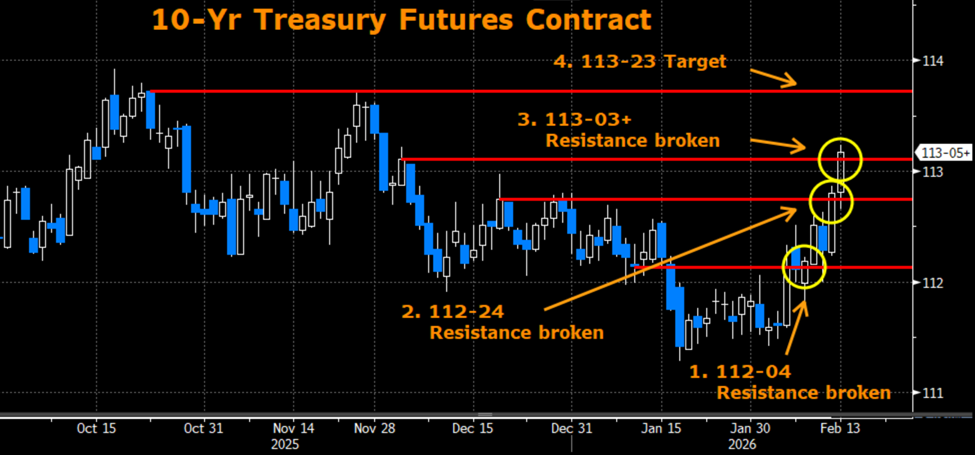
Last week, the SWBC desk took advantage of the rally to reduce short exposure once Treasury futures broke through key resistance. The strong weekly close implies additional upside potential, with minimal technical resistance until the 113 23+ area. While the desk remains attentive to potential retracements - particularly if prices fall back below 113 03+, near where we have established sell, we are ultimately looking to increase short exposure at higher levels. Selling into stretched market conditions remains a preferred strategy for enhancing alpha, then later adding to shorts after a more decisive trend reversal is established.
On the policy front, Kansas City Fed President Schmid noted that a path toward lower reserve levels is “not only feasible, but … something that should be pursued to allow for a smaller balance sheet.” Meanwhile, President Trump’s nominee to replace Powell as Fed Chair, Kevin Warsh, has not yet made public remarks outlining his priorities. His past advocacy for shrinking the Fed’s presence in financial markets - particularly through balance sheet reduction - continues to resonate with investors. While any balance sheet normalization would be a long-term undertaking, understanding Warsh’s stance will be increasingly important as the nomination process progresses.
From the Municipal Desk (with contributions from Ryan Riffe:
Municipal paper continued to trade stronger with help from heavy inflows, modest supply, and declining Treasury yields. Although the new issue calendar nearly doubled in size to $13.8 billion, it was no match for the voracious appetite of the municipal market. Negotiated deals were well received, as most were re-priced to lower yield targets, while competitive deals were firmly bid. With new issue allotments scarce, investors continued to be forced into sourcing bonds in an increasingly depleted secondary market. This, in turn, has kept Muni/UST ratios anchored to their already rich levels. Although monthly reinvestment capital will drastically fall as March approaches, the new issue calendar remains light as the market looks to price in just over $7 billion next week. As long as inflows remain positive, it will be difficult for municipals to cheapen on a relative basis to US Treasuries.
30-Day Visible Supply @ $10 Billion
Weekly Supply @ $7.1 Billion
2-YR Ratio @ 60%
3-YR Ratio @ 59%
5-YR Ratio @ 58%
10-YR Ratio @ 62%
30-YR Ratio @ 91%

An index is unmanaged and not available for direct investment. Definitions sourced from Bloomberg.
The Bloomberg Barclays Global Aggregate Negative Yielding Debt Market Value Index represents the portion of the Bloomberg Barclays Global Aggregate Index that measures the aggregate value of global debt with a negative yield. • The S&P 500® is widely regarded as the best single gauge of large-cap U.S. equities and serves as the foundation for a wide range of investment products. The index includes 500 leading companies and captures approximately 80% coverage of available market capitalization. • The NASDAQ Composite Index is a broad-based capitalization-weighted index of stocks in all three NASDAQ tiers: Global Select, Global Market and Capital Market. The index was developed with a base level of 100 as of February 5, 1971.• The Cboe Volatility Index® (VIX) is a calculation designed to produce a measure of constant, 30-day expected volatility of the US stock market, derived from real-time, mid-quote prices of weekly S&P 500® Index (SPX) call and put options with a range of 23 to 37 days to expiration.• The ICE BofA MOVE Index is a yield curve weighted index of the normalized implied volatility on 1-month Treasury options. It is the weighted average of implied volatilities on the CT2 (Current 2 Year Government Note), CT5 (Current 5 Year Government Note), CT10 (Current 10 Year Government Note), and CT30 (Current 30 Year Government Note), with weights 0.2/0.2/0.4/0.2 respectively.• The Markit CDX North America Investment Grade Index is composed of 125 equally weighted credit default swaps on investment grade entities, distributed among 6 sub-indices: High Volatility, Consumer, Energy, Financial, Industrial, and Technology, Media & Tele-communications. Markit CDX indices roll every 6 months in March & September. • The Markit CDX North America High Yield Index is composed of 100 non-investment grade entities, distributed among 2 sub-indices: B, BB. All entities are domiciled in North America. Markit CDX indices roll every 6 months in March & September. • The U.S. Dollar Index (USDX) indicates the general international value of the USD. The USDX does this by averaging the exchange rates between the USD and major world currencies. Intercontinental Exchange (ICE) US computes this by using the rates supplied by some 500 banks.
Investing involves certain risks, including possible loss of principal. You should understand and carefully consider a strategy’s objectives, risks, fees, expenses, and other information before investing. The views expressed in this commentary are subject to change and are not intended to be a recommendation or investment advice. Such views do not take into account the individual financial circumstances or objectives of any investor that receives them. All indices are unmanaged and are not available for direct investment. Indices do not incur costs including the payment of transaction costs, fees, and other expenses. This information should not be considered a solicitation or an offer to provide any service in any jurisdiction where it would be unlawful to do so under the laws of that jurisdiction. Past performance is no guarantee of future results.
© 2025 SWBC. All rights reserved. Securities offered through SWBC Investment Services, LLC, a registered broker/dealer. Member FINRA & SIPC. Advisory services offered through SWBC Investment Company, a Registered Investment Advisor, registered as such with the US Securities & Exchange Commission. SWBC Investment Services, LLC is under separate ownership from any other named entity. SWBC Investment Services, LLC a division of SWBC, is a nationwide partnership of advisor.

Let Us Know What You Thought about this Post.
Put your Comment Below.