
Housing market fundamentals remain challenging, with affordability continuing to be the industry's primary hurdle as home prices remain elevated relative to household incomes and price-to-income ratio...
Wall Street Shrugs Off Middle East Tensions as Consumer Strength Persists
President Trump’s indefinite extension of the ceasefire with Iran has done little to reassure financial markets or restore confidence in a return to geopolitical normalcy. Throughout the week, Iranian diplomatic intelligence pointed to only a very limited willingness to engage under U.S.-dictated terms. Late Friday, however, reports surfaced that Witkoff and Kushner were en route to Pakistan to hold discussions with Iranian officials. Whether this marks yet another false start or the beginning of a genuine resolution should become clear soon.
Kevin Warsh’s confirmation hearing last week unfolded largely as expected. Notably, Warsh emphasized the importance of Federal Reserve independence, stating explicitly that President Trump never asked him to pursue specific rate cuts - and that he would refuse such directives if he were ever asked. Perhaps most encouraging, at least from my perspective, was his critique of the Fed’s communication strategy. Warsh argued that the Fed speaks too often and, in doing so, frequently fails to deliver “important news.” Excessive communication has long been one of my frustrations with the current Fed regime, as too much noise often obscures genuine policy signals rather than clarifying them.
On Friday, the Department of Justice announced it would be ending its criminal probe into Chair Powell. This development likely clears the path for Warsh’s confirmation, as Senator Tillis had previously indicated he would block the nomination until the investigation was resolved. As such, the April 28–29 FOMC meeting could prove to be Chair Powell’s final one, assuming Warsh is confirmed in time to take the seat ahead of the June meeting. That said, as the late, great Yogi Berra famously opined, “It ain’t over till it’s over.” Until the confirmation is finalized, I remain cautious about declaring Powell’s tenure complete.
March retail sales data reinforced the picture of a resilient U.S. consumer. Sales rose 1.7% month over month, well above the 1.4% consensus forecast and significantly stronger than February’s 0.7% gain. This continued economic strength supports the Fed’s current decision to remain on hold, with incoming data offering little urgency to pivot toward easing.
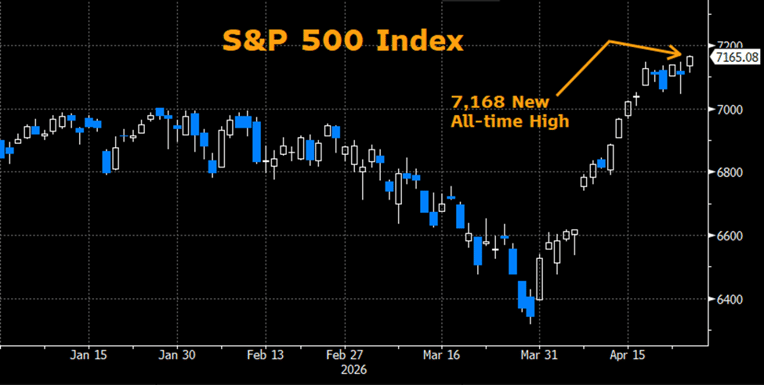
Equity markets extended their upward march, pushing to a new all‑time high of 7,168, as optimism around economic growth continues to outweigh concerns surrounding persistent Middle East uncertainty. Oil steadily rose throughout the week, regaining the $100/bbl level, and will be closely monitored going forward. The bond market, however, displayed more skepticism, with the 10‑year Treasury yield drifting back above 4.30%. There remains ample time for my 7,700 S&P 500 year‑end target to materialize. The nearly 10% correction during February and March proved to be more of a pause than a reversal—and, for disciplined investors, a meaningful buying opportunity.
Looking ahead, this week features what could be Chair Powell’s final FOMC meeting, followed by the release of Personal Consumption Expenditures (PCE) data - the Fed’s preferred measure of inflation. Consensus expectations call for a 0.3% increase in March, easing from February’s 0.4% gain, but with year‑over‑year inflation edging higher to 3.2% from 3.0%. If realized, these readings would reinforce the Fed’s current wait‑and‑see posture, as convincing evidence of disinflation has yet to emerge. At the same time, the unemployment rate has remained relatively stable in recent months, even as job growth has moderated, leaving policymakers with little urgency to adjust course.
From the Municipal Desk (with contributions from Ryan Riffe):
The municipal curve continued to flatten over the week, with front‑end yields rising by as much as 9 basis points. The SIFMA Short‑Term Variable Rate Index has now held above 3.60% for a second consecutive week, sustaining pressure on front‑end fixed‑rate munis. Further out the curve, benchmark yields in the five‑ to thirty‑year range were largely unchanged, as demand remained concentrated in longer maturities where relative value continues to look most compelling. Weekly Lipper data reflected nearly $1 billion of municipal fund inflows, providing a steady technical backstop for the market. Looking ahead, new‑issue supply is expected to decline meaningfully, falling from $14.1 billion to $7.7 billion. A lighter calendar, coupled with the influx of May 1 reinvestment capital, should prove supportive and help pull yields lower. While the front end has lagged amid recent weakness, that softness may offer a timely entry point ahead of the typical seasonal pickup in summer demand.
Weekly Supply @ $7.7 Billion
2-YR Ratio @ 62%
3-YR Ratio @ 62%
5-YR Ratio @ 64%
10-YR Ratio @ 67%
30-YR Ratio @ 87%
 An index is unmanaged and not available for direct investment. Definitions sourced from Bloomberg.
The Bloomberg Barclays Global Aggregate Negative Yielding Debt Market Value Index represents the portion of the Bloomberg Barclays Global Aggregate Index that measures the aggregate value of global debt with a negative yield. • The S&P 500® is widely regarded as the best single gauge of large-cap U.S. equities and serves as the foundation for a wide range of investment products. The index includes 500 leading companies and captures approximately 80% coverage of available market capitalization. • The NASDAQ Composite Index is a broad-based capitalization-weighted index of stocks in all three NASDAQ tiers: Global Select, Global Market and Capital Market. The index was developed with a base level of 100 as of February 5, 1971.• The Cboe Volatility Index® (VIX) is a calculation designed to produce a measure of constant, 30-day expected volatility of the US stock market, derived from real-time, mid-quote prices of weekly S&P 500® Index (SPX) call and put options with a range of 23 to 37 days to expiration.• The ICE BofA MOVE Index is a yield curve weighted index of the normalized implied volatility on 1-month Treasury options. It is the weighted average of implied volatilities on the CT2 (Current 2 Year Government Note), CT5 (Current 5 Year Government Note), CT10 (Current 10 Year Government Note), and CT30 (Current 30 Year Government Note), with weights 0.2/0.2/0.4/0.2 respectively.• The Markit CDX North America Investment Grade Index is composed of 125 equally weighted credit default swaps on investment grade entities, distributed among 6 sub-indices: High Volatility, Consumer, Energy, Financial, Industrial, and Technology, Media & Tele-communications. Markit CDX indices roll every 6 months in March & September. • The Markit CDX North America High Yield Index is composed of 100 non-investment grade entities, distributed among 2 sub-indices: B, BB. All entities are domiciled in North America. Markit CDX indices roll every 6 months in March & September. • The U.S. Dollar Index (USDX) indicates the general international value of the USD. The USDX does this by averaging the exchange rates between the USD and major world currencies. Intercontinental Exchange (ICE) US computes this by using the rates supplied by some 500 banks.
Investing involves certain risks, including possible loss of principal. You should understand and carefully consider a strategy’s objectives, risks, fees, expenses, and other information before investing. The views expressed in this commentary are subject to change and are not intended to be a recommendation or investment advice. Such views do not take into account the individual financial circumstances or objectives of any investor that receives them. All indices are unmanaged and are not available for direct investment. Indices do not incur costs including the payment of transaction costs, fees, and other expenses. This information should not be considered a solicitation or an offer to provide any service in any jurisdiction where it would be unlawful to do so under the laws of that jurisdiction. Past performance is no guarantee of future results.
© 2025 SWBC. All rights reserved. Securities offered through SWBC Investment Services, LLC, a registered broker/dealer. Member FINRA & SIPC. Advisory services offered through SWBC Investment Company, a Registered Investment Advisor, registered as such with the US Securities & Exchange Commission. SWBC Investment Services, LLC is under separate ownership from any other named entity. SWBC Investment Services, LLC a division of SWBC, is a nationwide partnership of advisor.
Let Us Know What You Thought about this Post.
Put your Comment Below.